Friday, April 14, 2006

First Comics Week: The Twisted Mind of a Twelve-Year-Old Girl.

(With Apologies to The Invincible Super-Blog! as I can't stop myself from wandering into his style for this one.)

When Chris Holly declared it First Comics Week, naturally the first thing I thought of was the comic that brought me to DC -- "The Return of Barry Allen."

But there was an earlier one. I didn't think of it until a few hours later, but once I did I remembered vividly the opening scene. I remembered having watched the X-Men cartoon. My sister reading the comics, her endless nagging, picking up a book because it featured kids close to my age, a blonde jogger, a girl on a park bench, and a panel which downright blew my mind!

Unfortunately, the comic belonged to my sister. In Pennsylvania. And I wanted to reread it before I posted about it. I spent the next few lunchbreakss at local stores, and yesterday I found it. There it was in the dollar-bin, with it's pretty, shiny silver cover. Generation X #1

My childhood for ninety-nine cents. What a bargain!

I was nervous when I brought it home. My hands were trembling as I fumbled with the polybag. What if I was suffering from... Nostalgiavision? Would it live up to my memories? What if it sucked? What if now, that I've trained myself to notice the symbolism, it completely and utterly insults the hell out of me? What if this means that I can never, ever return to Marvel, even after Joe Quesada retires? I nearly chickened out.

But no, I opened the bag, I read the book, and I learned a valuable lesson.

I worry too damned much.

It was a transcendental experience. I became as a child when I realized that I have still not recovered from my first reading of this comic -- 12 years ago! Merely rereading this comic caused me to abandon all pretenses of reason and reflection. I regressed to the mental state of a babbling twelve year old fumbling for words to describe the beauty, power, and wonder of what she had just read. My vocabulary dissolved, the adjectives were slipping away from me and the only way I could describe the book was to say that it was totally awesome!

This is the way team books should be done.

The first panel features the orange sun, low in the sky in the early morning. The narrative captions (third person, baby!!) describe the Dawn. The first character introduced is running. Not away from anything, towards us, towards the reader. The narrative describes her as Paige Guthrie, a mutant. And her thought balloons (thought balloons!) Her head and feet extend outside the panel boards. The panel cannot contain her power!

This overtaking the panel trick is done for every character introduction in the book except Jubilee (who gets a full page). It's always full body shots, a good way to show off a character. And the poses fit the personalities of the characters. Paige is running forward. Jubilee's sitting on a park bench in monster slippers and whining about being up too early. Monet descends from above, correcting the other character's vocabulary.


Oh Monet, how I adored Monet in this! I think it's because she struck me as a black female Superman. Look at her first appearance. Perfect Superman pose -- red and blue clothing, arms outstreatched, palms open, one foot is kicking back so fast we can't see it, the other extended forward to land on Earth, the sun glints off her spandex and her hair sweeps back in a very capelike manner. She completely comes across as Supermanesque despite being a total snob. Hell, it adds to her. She'd be so flat as a outwardly sweet person. I still think Marvel should play her up as their answer to Superman. It would work. I would completely do that if I were Marvel's Editor-in-Chief.

Later on in the book, she's climbing a tree. In a preview profile, it notes that she describes boys as "icky" and later on in the series she's caught with a coloring book. So yes, this was hint-dropping for a future plot (her baby sister was impersonating her or something stupid -- I'd stopped reading after Age of Apocalypse was done), but I liked it. I wish that childishness would come back as a side effect of her super-intelligence. It softened an otherwise harsh character.

Later on, they introduce some of the boys. The only one I cared for was Synch because he was a copycat power, and if I were in the Marvel Universe that is what kind of mutant power I would want -- the power to have everyone else's power. But the White Queen makes a strong first appearance, setting herself up to gain my eternal fanitude a few issues later.

Once everyone is introduced, they all go to an airport and have the obligatory coincidental run-in with a supervillain -- a supervillain a teammember knows! Monet knows Emplate, who is there after Chamber, because from this point on, in this and every comic he appears in -- Chamber is the center of the known universe. He has that much power.

And of course, at the end, a mystery teammember is introduced. A teammember who leads into the next issue and ties importantly into future plotlines -- many of which I never saw resolved, because this, after all, is an X-Men comic and nothing every gets resolved.

I thought Penance, purely by her character design, was Unutterably Cool. Let's look at it from a twelve-year-old standpoint, shall we? Bright colored skin? Check. Nineties name which makes no real sense but sounds cool? Check. Pretty face? Check. Long Hair? Check. Giant Razorblades for Hands? Check. Giant Firkin' Razorblades for Hair? Check. Mummy Wardrobe? Check. Mysterious, sinister past? Check. She was my Wolverine.

All in all I have to say (and I am biased!) that this is the strongest first issue of a team-book I've ever seen. I hadn't read the crossover that led to the team, and I didn't have to. I only knew Jubilee (from the cartoons) but I got a very clear impression of the other major personalities in this issue. The team was built in a wonderfully 90s manner -- half male, half female, with a carefully thought-out ethnic diversity. Which was beautiful because this way, when the team was portrayed out of costume, you could tell them apart! If only Young Justice had considered that when they brought in female characters!

None of this occurred to my twelve-year-old brain initially. It helped that the characters were close to my age, and it helped that the strongest personalities were female, but to tell the truth I was hooked from one panel.

You see, as a child, I was fascinated by snakes. Whenever we visited a zoo or saw an animal handler show or any of that neat stuff they do for schoolkids to get them interested in science, I was drawn to the snake. If I could pet the snake, I would. If I could see a snake, I'd be peering in the aquarium dealy. I asked my mother for a snake several times (she hated them). Everytime I had the opportunity to get my hands on a discarded snakeskin (which, alas, was all-too rare), I took it and I saved it until my ophidiophobic mother tossed it and made "eww" noises. My favorite person in Greek Legend? Medusa.

This was all because I found the idea of an animal that could shed its own skin absolutely fascinating.


Yes, Ladies and Gentlemen, that was a girl ripping her own skin from her body.

Please Note: All references to Chuck Austen are expressly forbidden in the commentary. It Never Happened.

Wednesday, April 12, 2006

The Cliche Writers Can't Refuse

He was an older man who reminded me of my father. I was escorting him while he was doing an all-day job in a secure area. This is long and tedious from both our points of view, and eventually, running out of conversation fodder, he asked about my name.

"Actually, it's Italian." I answered.

"Really? Oh yeah, that's a Latin root..." which was followed by inquiry into how it ended up so mangled. Immigration issued name (I suppose it would be more accurate to describe it as an American name). When he asks what part of Italy, and why my great-grandfather left, I have no answer.
That's when It comes.

"You know, an Italian man, fleeing his homeland, mysterious past. Could be running from the Mafia."

~_~_~_~


(Consider this your Catch-22 Spoiler Warning)


I can't rightfully complain (but that's never stopped me before). I contributed to our cultural obsession by supplying demand to numerous suppliers. I was mildly obsessed with the Mob in High School. I watched the movies, I read books about it, I went out of my way to catch TV documentaries... I ate it up.

It's sexy and exciting. The seedy underbelly of the naked city, bad men at their worst, good men at their worst, decades of history, generations of accumulated power, hot Mediterranean desires, dark-haired goddesses married to ugly men with no necks, intense Catholic guilt, honor stretched to the limit, men kissing, that string music in the background, one more job and I'll be done -- I swear Mama! The writers do it on purpose, and many of them do it well. To make a good story, you glorify and glamorize the genre.

There is a price with this glory and glamour. I'm not talking the price of crime here -- lives and broken hearts. I'm talking fiction here, not reality. People's business is their own business, and if their business is crime it's their business, not mine. I'm studying pure stories and their effect on attitudes. Attitudes which intrude into my life and the life of every Italian American in America, asking The Question.

(No, not that Question.)

"Does your family have any Mob Ties?"

I remember the first time I heard The Question, in any of its myriad syntaxes. Maurice from my first duty station. He lived next door in the dorms, and played his music all night. Loved "gangsta rap." I even remember the name of his favorite duo -- "Capone n Noriega." I'd pound on his door nightly to make him turn it down. He was especially excited when the conversation turn to heritage, and he was the first to seriously ask -- "You in the Mafia?" I was more than a little taken aback. I'd grown up in a heavily sheltered area, with specific ethnic groups. Italian, Polish, Irish, we all made our jokes. Maurice wasn't joking.

He wasn't the only one.

After years and years of romanticizing and fictionalizing the legacy of Al Capone and other Ethnic Organized Crime symbols, an Italian last name becomes dramatic shorthand for "Mob Ties." Oh, how I hate Mob Ties! You know it when you see it on TV. Any cop with an Italian name gets an episode where he runs up against the local Don (who also knew him from a child!) or has to save a wayward relative from "The Life" -- and don't forget, the added Catholic Guilt. In any Crime Drama, eventually, the writer will bring in the Mob for the Italian character. In any comic book, you see it coming. They'll be at least related to a guy who works for the local Boss. They'll most likely know the local Boss themselves. Be actively working for them. Every Italian in comics is connected to The Mob, and of course, every Italian in Gotham City is a card-carrying member of The Mob.

I still enjoy the fiction, to an extent. I like a good Noir movie, old classics in black and white. I'm a sucker for the funny Mob movies like Analyze This and The Crew. I still romanticize fedoras, Italian suits and New Yorker accents. In the right mood, I can even stomach the serious stuff. This is getting more and more difficult anymore, especially as I like Crime Dramas and even when it's not Mob-centered, Mob Ties somehow find a way to slink into the plot. It was okay, back in the Poconos, where everyone was Italian, Polish or Irish and knew what your life was really like (or at least, knew what that insinuated when you asked a cop's daughter), but away from home it gets hurtful. Not only do they spout tired ethnic slurs, they ask The Question. "Is your family in the Mafia?" If they were just joking to break the ice would be one thing, but they ask with a greedy interest like I have stories to tell and connections to act on. People actually think we're like that!

"Any Mob Ties?" It's so insulting!

Generally, the fun part of Mob Ties -- the actually being a bad guy as opposed to just being related to one, went to the men. But not to worry, the Spawn of Capone had a Bride. The Hot-blooded Italian Woman, who actually predates the Mob Ties cliche. I think this one first materialized, for me, in Catch-22 when Nately died. The is the point where Nately's Whore, previously a dismissive and humorous side-character (I swear her only line in the entire book is "Idiota!") goes batshit crazy and dedicates her existence to the Destruction of Yossarian. This homicidal background character becomes representative of all Italian women in American media to me. Her beneficial purpose is purely sexual, and is usually the backstory reason for her inclusion. Her more practical and malicious purpose, storywise, is to throw a wrench in the works. She's the irrational, emotional woman there to make the main character's life much more difficult. "Italian women are nothing but trouble!" the adage goes, and this woman, present to fill any necessary Italian female presence (because, you know, if the character is rational, she can't be Italian) is all too happy to prove it.

I love the stereotype and hate the stereotype. As a rule, generally embrace anything that makes me scarier to other people. And again, the humor. She was the funniest character in the book. But I despise the effect, the one that paints me as irrational, emotional, and violent. The one that invalidates me everytime I get angry, because that's just the Italian in me getting worked up. The one that makes men laugh and joke when I'm seeing red. The one that assumes my Father is corrupt, my Mother is a blind, my brother is spoiled and violent.

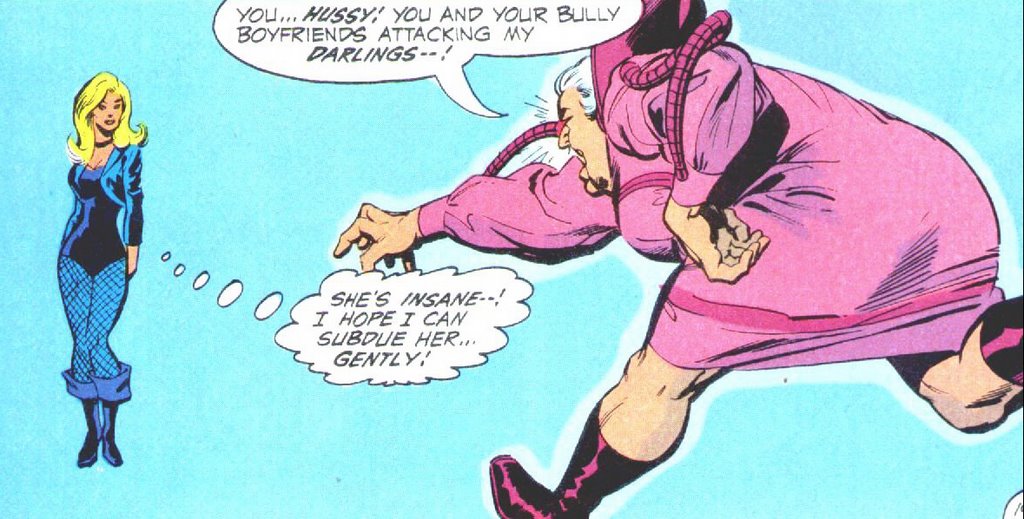
It's why I never cared for the Huntress. She's both stereotypes mixed into a sickeningly over-the-top combination. Helena Bertinelli just couldn't be a schoolteacher with a crossbow fetish. No, she had to be the Mob Princess, embodiment of the Italian-American Stereotype, with her religion plastered across her costume and her entire family's skeleton's filling numerous walk-in closets. She's the hot-blooded Italian woman, the one who turns men on for her passion, unpredictability, and danger. She's Nately's Whore, Americanized, with Mob Ties, and reincarnated in Eighties comics. Sex and violence in a black-haired supple-breasted tight-abbed Catholic-girls-gone-wrong package. Way too much of a stock Italian-American character. Heavily Catholic, pampered, violent, oversexed, raised to glorify honor among thieves, hot-tempered, and bloodthirsty. Whether she embraces or rejects "The Life" she's a formulaic fiction femme fatale.

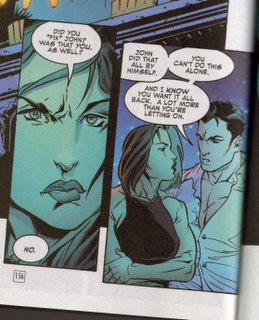
I didn't realize any of this until I saw the panel at right. Now, it's not the panel, or even the joke itself that offends me. I laughed at that joke in Birds of Prey when I saw it. I initially enjoyed it, still enjoy it on one level, I'm not inclined to dislike anything that makes me scarier. It's what the joke makes me realize about the character that's weighing on me. And the more I think about it, the most disgusted I get. Before this moment, I never clicked with Huntress and in one moment I clicked with her and realized why she was ultimately unacceptable to me. I'll still enjoy seeing her hit people, of course, but I can't really enjoy a character study. Not the Catholic/Mob Princess Angst stuff. "You don't mess with Italian girls." Why? Because they are crazy hot-blooded Mediterranean vixens. You can't predict them. They don't make sense. They don't follow logic. They're just animals. It's Nately's Whore, taking it out on Bat-sarian (well, Slade-sarian in that case). Just a crazy woman who doesn't understand what's going on, so you'd better avoid her. The sum of Huntress's Post-Crisis concept -- "You don't mess with Italian girls." We're not thinking beings.

To be fair to the Huntress, even in my Mob-obsessed phase Italian-American comic book characters just never did it for me. Too contrived. Too stereotyped, too insulting.

Well, in general.

There was an exception.


In the fifth Starman trade paperback, I encountered a first. The one Italian-American comic book character that I could stomach. Hell, I even liked this one.

Bobo (He hates that name) was not born to a life of violence, instead, he chose to pursue violence -- honestly, at first. He went with the Marines to Korea, and got injured. In a wonderfully underexplained origin typical of 90s comic books, he discovered that he was invulnerable, super-strong, and immortal. He would use this power, for personal profit. He could use this power to rob banks. And fight Superheroes!


Hey, I never said he was upstanding citizen, just that I liked him.

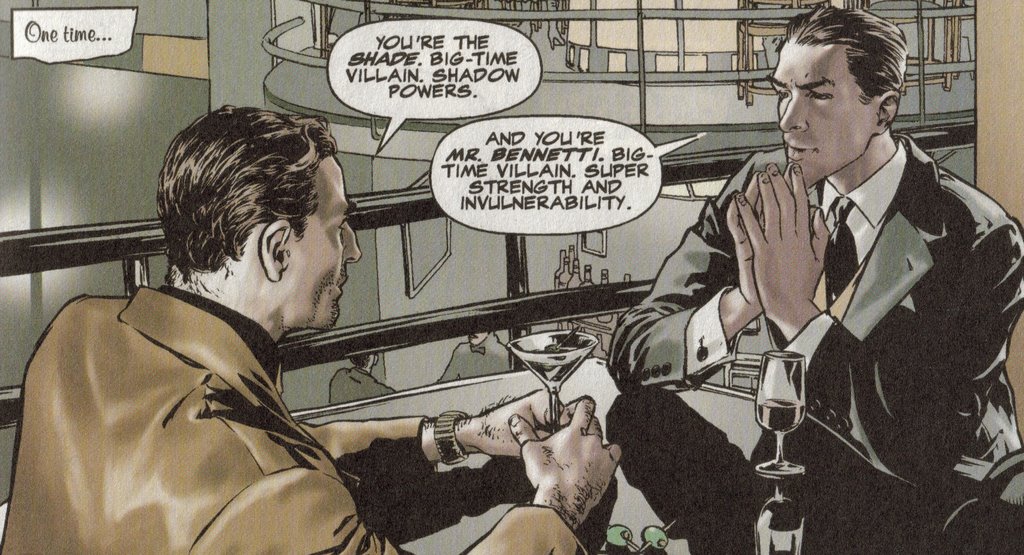
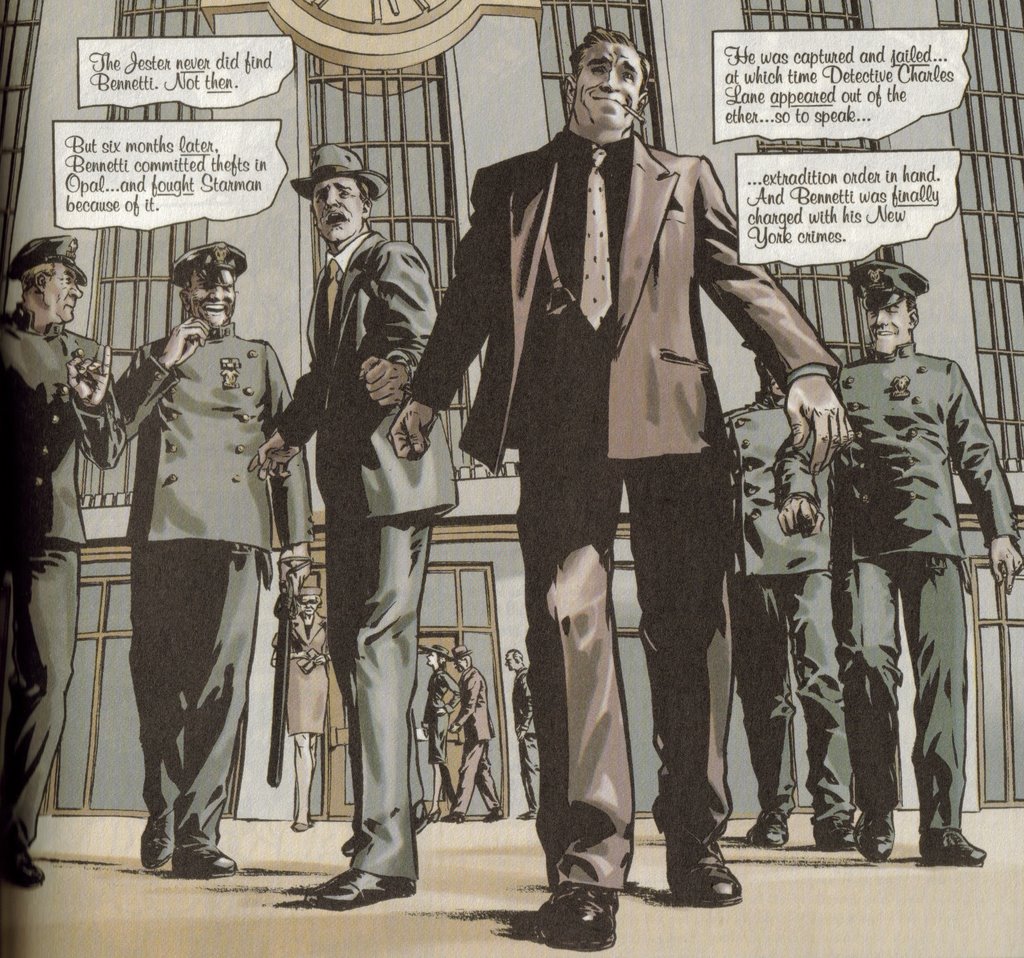
Jake "Bob" Benetti does have ties to Crime. It's not to an ethnicized, romanticized, organized criminal empire, though. Bobo, like any super-strong bank-robber should, belonged to the Super-Villain community. His most powerful ally was not a neckless overweight old Godfather ripoff, but Opal City's Oldest Living Resident and Most Popular Dickinson Throwback, The Shade. He has a fun personality, one of those big, open, plainspoken people. Like pretty much all of Opal City, he was era-displaced. Bobo belonged in the forties and fifties. That was because of an extended stay in prison. He felt so displaced when he got out, actually, he intended to go back in. Fortunately, The Plot intervened and an old supervillain became a new superhero! As time went on and we focused on Bobo, Mob Ties never revealed themselves in the course of the series. We saw a Times Past story, and Mob Ties never revealed themselves. We saw a guest-shot in Catwoman, and Mob Ties never revealed themselves.

In fact, there's a storyline where The Mob is (are?) the featured villain, and Bobo Benetti is fabulously, marvelously, gloriously NOT INVOLVED IN THE SLIGHTEST!

And in that storyline, that single issue, the Formerly Corrupt Cop Matthew O'Dare, and his Utterly Fantastic Friend the Shade deal each and every Mafia character in the entire city a gruesome horrific death. Thus ensuring that Jake "Bobo" Benetti, this one beautiful, wonderful, divinely three-dimensional Italian-American character can hold his head high and walk proudly out of the police station, free of that banal affront to character background most commonly found in the toolbox of the hack writer -- Mob Ties.

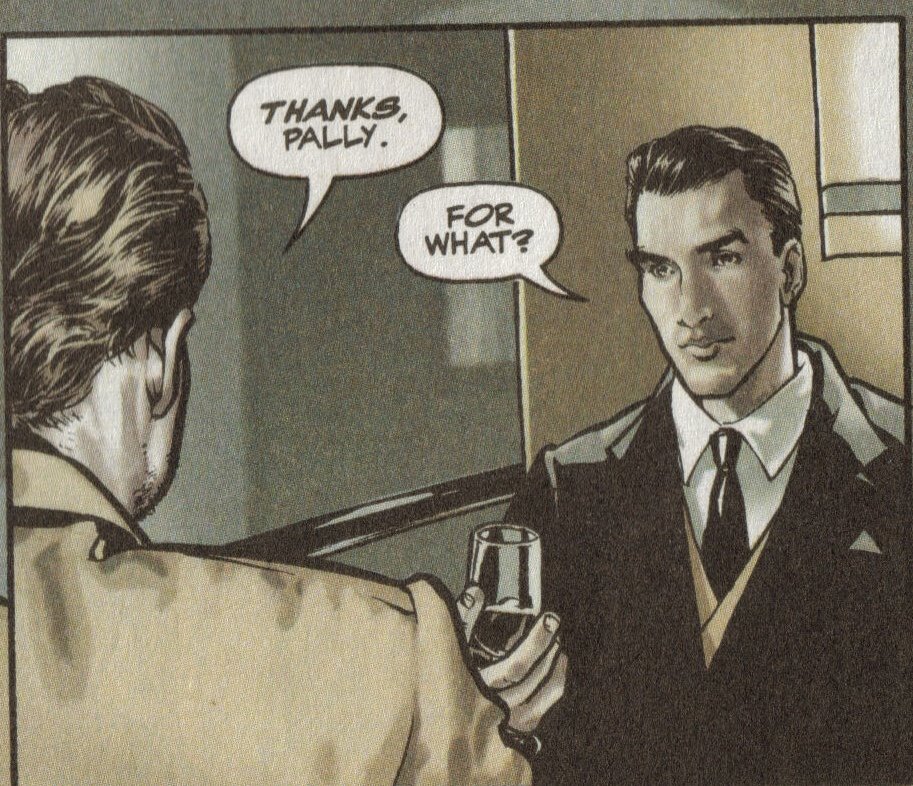
What's notable about this panel?


Here's a hint.

Tuesday, April 11, 2006

Taki Soma

While I can't imagine anyone reads this blog and doesn't know about When Fangirls Attack, I still figure this one should get wider distribution if possible. Remember the sexual assault scandal that broke in Buzzscope in December? The names were kept under wraps until the elga difficulties were ironed out. Well, Ronee's done a follow-up and Taki Soma has come forward. Here's her story.

Monday, April 10, 2006

The Flash is Starting to Scare Me II

And now, a joke only DC Readers will get...

From Hanzi Smatter by way of a friend's livejournal:

Surprised by the translator’s choice of using [chinese characters] as “Jordan”, I asked Scott if that was a mistake.

?? ????? (n) downstream; lower reaches of a river; lower classes

He replied in a second email that this was indeed not a mistake. He also told me he got the translations from Eri Takase.

Wierd Searches

How did I get a hit for "winnipeg sluts"?

Sunday, April 09, 2006

It's Too Early In The Day For This Much Misogyny

I'm going to cheat today and share with you some e-mail correspondence from last week. Those of you who have a weak stomach for criticizing writers may want to skip this one (Though I did link to those who already had a chance to respond to the Refrigerator list)

Hey Ragnell,

You're way more the Green Lantern fan than I am so I was wondering if you could tell me whether I'm being oversensitive or whether GL is very misogynistic? I knew they'd killed off Katma Tui, Jade, and Alex DeWitt, but I hadn't realised that Arisia had gone too (after having various nasty things happen to her). A couple of months ago I saw the GL episode of Duck Dodgers and there was a female GL I hadn't seen before so I looked her up in the the unnoficial guide to the DC universe website, and guess what? Dead. Add Carol Ferris turning evil and it's beginning to look like the odds are stacked against any female who spends any length of time near one of those rings.

Am I mistaken? Is there just a high mortality rate generally in and around the Corps? Are there any female characters in GL that have lasted long term without becoming vicious murderers? 'Cos right now the whole thing is just depressing me.

Mari


Yes, I did answer her.
Actually, I think about this one all the time. I don't think the concept or the franchise itself is misogynistic, but there's so many disposable characters and so few of them visibly female that one misogynsitic writer can do a lot of damage. Carol Ferris, for example, started out a really amiable "villainess" -- She was basically powered by the Zamarons to make a little trouble. She didn't turn evil, I think, until Preist got ahold of her in Action Comics Weekly. He's the same writer who killed Katma Tui, another character who'd been treated respectfully up until then.

I can see a lot of misogyny in Denny O'Neil's run. He played with all sorts of social issues but for some reason couldn't do feminism without making the guest-women evil (Mother Juno, the visiting Amazons, Sinestro's Evil Sister). He crippled Carol (a later writer fixed her legs, haven't seen that yet) and created Kari Limbo (Check out Kalinara's post). Black Canary got alternately moronified and glorified, though I can't get over her first appearance in the run (she gets brainwashed, dammit). Fortunately though, his punching bag was Guy Gardner. Guy was injured so that John could be brought in, then Guy was kidnapped and driven insane to give Hal some angst. Then he put him in a coma for safekeeping for next time he needed to cause Hal angst. This kept the run free of the Fridge Factor.

I haven't read all of Steve Englehart's run. I do have to say the very concept of the Arisia aging story -- where she's the sexual predator artifically aging herself and tricking Hal into bed doesn't look good at all. I also hear this was where the Predator/Carol storyline was introduced, and I've heard bad things about that. Green Lantern #192 made my blood boil from the displayed sexism (Though, as Kalinara pointed out, that was sexism attributed to a character, not stated in the narrative, so I have to read the whole story to see how it turns out). But most of the stuff he wrote with Katma was absolutely beautiful.

I'd say the turning point into misogyny was the Death of Katma Tui. Because Action Comics Weekly #601 featured three awful blows to femininity -- Katma died (on the kitchen floor!), Carol was made into a psychopath (a far cry from the playful rival of Broome and Fox's days), and Arisia was turned from a mixed-up kid who still had the willpower to save a planet, into a bubble-headed model/sex-toy for Hal. Come to think of it, Hal and John didn't do too well in this run either.

Earlier writers like John Broome and Gardner Fox were much better. They created Katma and the Zamarons (who were actually pretty cool and reasonable, if chauvinistic, at the start), and set Hal up with I think the only Silver Age girlfriend who was actually her boyfriend's boss.

Gerald Jones introduced Brik and Boodika, resurrected Katma but kept Carol insane. During his run, we had GLC Quarterly, which while not always written by him introduced some decent female characters. We got the story of Laira, a conflicted daughter; Sheriff Mardin (Her origin is on Scans Daily if anyone's interested), who preferred not to use the ring at all when taking care of her territory; and Donna Parker, an Earthwoman who was offered the chance to be a Green Lantern, but turned it down (she was a 50s mother). I got the indication he had more for them to do, but unfortunately, Emerald Twilight screwed all of them over. Boodika and Laira were cannon fodder for Hal's rampage, and everyone else lost their powers. This abruptedly ended Green Lantern: Mosaic, where they'd resurrected Katma, which led to a retcon of Katma's resurrection.

Ron Marz's run doesn't really bug me so much, even though he is the one who did the infamous Refrigerator Scene. I don't think he's a misogynistic writer, as he writes Sara Pezzini pretty much the same way he writes Kyle (which is what gave me the problem with the sexual harassment storyline. He's done that story setup to Kyle too, handing the Act III victory to a guest-star, but he never handed Kyle that subject matter), though he does have crappy moments he should be called on. The main problem with judging him was that during his run they were doing an All-Lantern Purge. He was building a period of darkness, tearing down every element in the mythos and creating an atmosphere of death and destruction. Minor Lanterns, which was most of the remaining female ones, got killed off or never shown again. Kyle's first girlfriend Alex was created to die, but she treated fairly up to then. Hell, as a hapless girlfriend she made a better showing in her death story than Katma Tui, an experienced hero, did. He got two editorially determined love interests (both of whom were photographers, just like Alex!) that, unfortunately, he wrote in character. Both of them got pulled by the editor. He removed Carol's insanity, but also removed her power (her connection to the Zamarons), in an attempt to remove her from the franchise. Kyle's most formidable (until the next writer got ahold of her) enemy was female. Kyle's mother, Maura Rayner was actually a pretty good character. The real test of Marz and Green Lantern is how he'll handle Kyle's next love interest, the one (hopefully) that he's created himself that's not editorially controlled by another book.

Arisia seemed safe for a while, shuttled over to Guy Gardner: Warrior. Beau Smith had several fun and interesting female characters in the supporting cast (Lady Blackhawk and Fire made appearances; Arisia, Guy's mother Louise, and Verrona were regulars) and if you do searches you'll find rumors that he'd planned to bring Arisia right back, so I don't think misogyny factored into this one.

I'm a bit worried about Geoff Johns right now. In Green Lantern: Rebirth, he brought everyone back but Katma and Arisia, for starters. He shuffled Carol off to married life. He introduced one female supporting cast member, as a rival pilot. On the other hand, he has added an important mother influence to Hal's backstory -- which is important in the father-obsessed DCU -- and he's done a good job with females over in the JSA franchise. Green Lantern #10 put me more at ease in this respect. Yes, OYL he still has no viable love interest. It had a plot point that seriously put me off the story, but on the plus side it brings Cowgirl to prominence, removes the rivalry and effectively saves her from "notch in the bedpost" status by forming a non-sexual basis for their relationship.

Dave Gibbons has two good points for him -- returning Brik and creating Soranik. I personally consider killing Jade a pro-feminist act for reasons of my own, but he the way he did it was pretty damned symbolic and insulting (using a door that was opened by Winick). That's one against him. There's also a severe lack of visibly female background characters. I think I counted only two (An insect lady at the morning briefing and the girl with the hat in my in the recharge scene -- this could be the decision of artist Patrick Gleason) in the entire Green Lantern Corps: Recharge miniseries.

The worst, however, had to be Judd Winick. Because he tricked* us (and possibly himself) into thinking he was pro-feminist. He repowered Jade, right? That's good, returning a "strong" female to the cast, right? Not if she has to depend on Kyle to get her powers back. He outright tells her "You can't do this alone." That set up my warning flag. She can't get her powers, which are her inheritance back unless he gives them to her. It's a backhanded way to empowerment.

Winick then took Maura Rayner and turned her from a realistic looking woman into a Middle-Aged Barbie Doll. (Though, as Kalinara points out in the comments, that may be more the result of Dave Eaglesham's art). He takes a formerly formidable villainess, Fatality, and turns her into a crying little girl who doesn't have the willpower necessary to tame a weapon that matches Kyle's (a weapon used successfully in the next storyline by a male villain who is also a mental patient). He brings back the Guardians as both genders, then shows that the female adult version is strong and formidable by quickly aging one of the little girls, dressing her like Vampirella, sending her on an uncontrollable rampage because her mind is so childlike, weak, and simple that she needs Papa Smurf--err, Ganthet the oldest Guardian to step in and take control. Then he adds insult to insult, insult, insult and insult and brings the Zamarons back, as Nursemaids.

On the whole, I'd say Green Lantern history has been more misogynistic than feminist. I don't think this is an evil inherent in the franchise or even started by the early stories, but that could be my own natural inclination to give it a pass. I love the Green Lantern concept. Instant Manifestation of whatever you imagine in beautiful glowing green light! Such wonder and power in your hands. I hate to think of it as a boy's club. But sometimes, you have to just bite the bullet and open the fridge. And sometimes, it's mighty crowded in there.

*Judd Winick also introduced a gay character specifically to be beaten to a bloody pulp. When he cured John Stewart's paralysis he made sure to add a horrific and unnecessary mistake of causing his younger sister's death to John's already smeared backstory. He introduced Hispanic heritage to the Green Lantern mythos through Kyle's long lost father, Gabriel Vasquez. Gabriel had been successfully posing as an Irishman named Aaron Rayner when he met Kyle's mother, he left shortly thereafter. Thus, the big-name Hispanic hero Winick "snuck in" under the radar (in what smells awfully like an attempt to cheat us out of brand-new quality characters of diverse background) looks white, and was raised in an Irish pride household completely and utterly ignorant of anything other than Irish heritage.

Saturday, April 08, 2006

The Flash is Starting to Scare Me


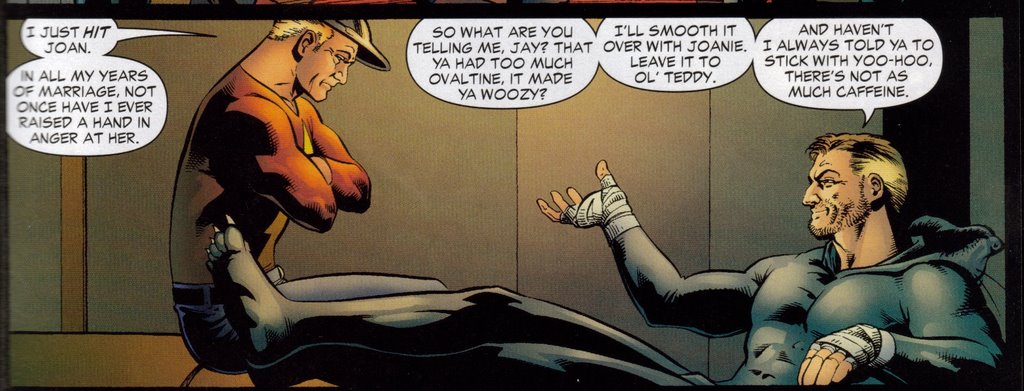
In the next panel, the Flash gets very angry for this insinuation.

Chris points out that Wildcat sounds awfully creepy there.

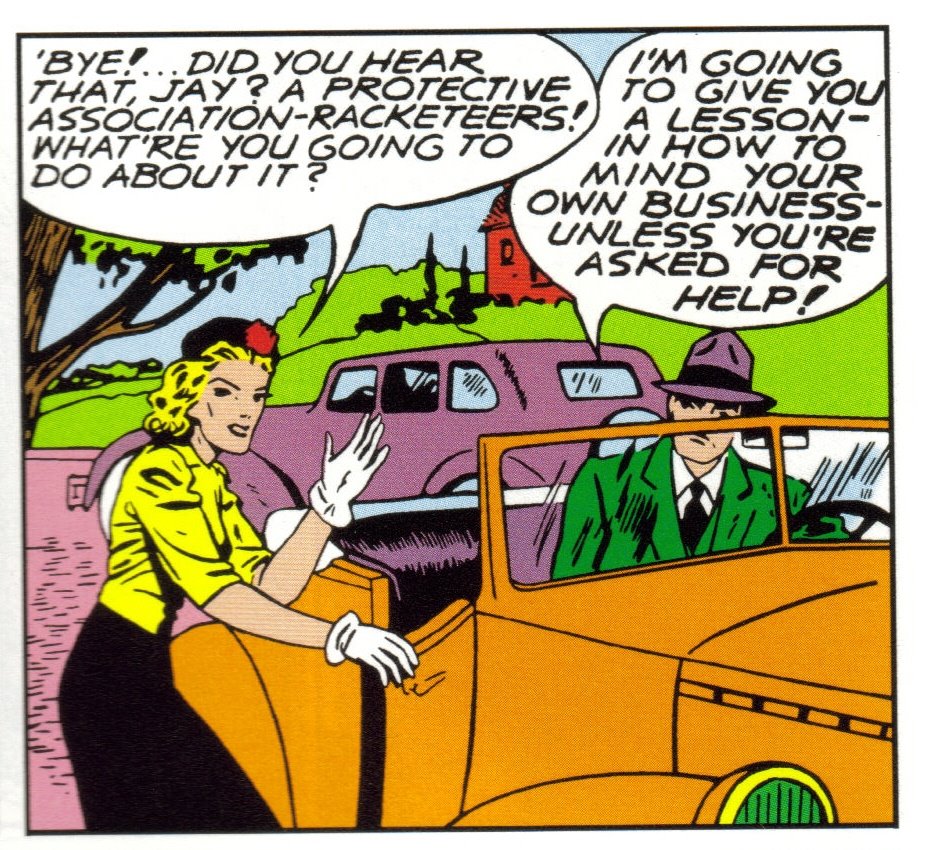
I just wondered where Ted could have possibly gotten the impression that Jay would hit his wife... Until I saw the Golden Age Flash Archives, Volume 2

Friday, April 07, 2006

The Star Sapphire Tutorial

Mallet asked for clarification on Star Sapphire's continuity last post. You see, on the very same day I had Star Sapphire guest-blogging, she appeared in Infinite Crisis #6. Two Star Sapphires? How is that possible? Was Wednesday's Carnival of Feminists a hoax, a dream, or an imaginary story?

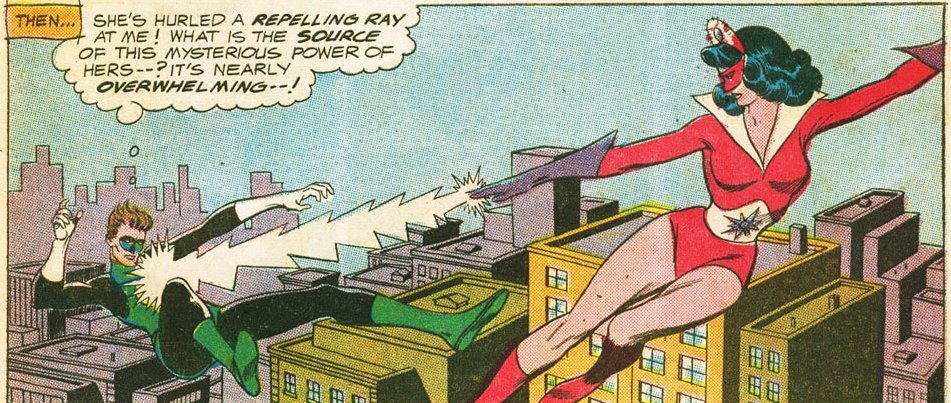
No, actually, the explanation is very simple. Wednesday's Guest-Blogger was Star Sapphire II. The lady we saw in Infinite Crisis #6 was Star Sapphire IV.

Click Here for a Short Guide to Star Sapphire

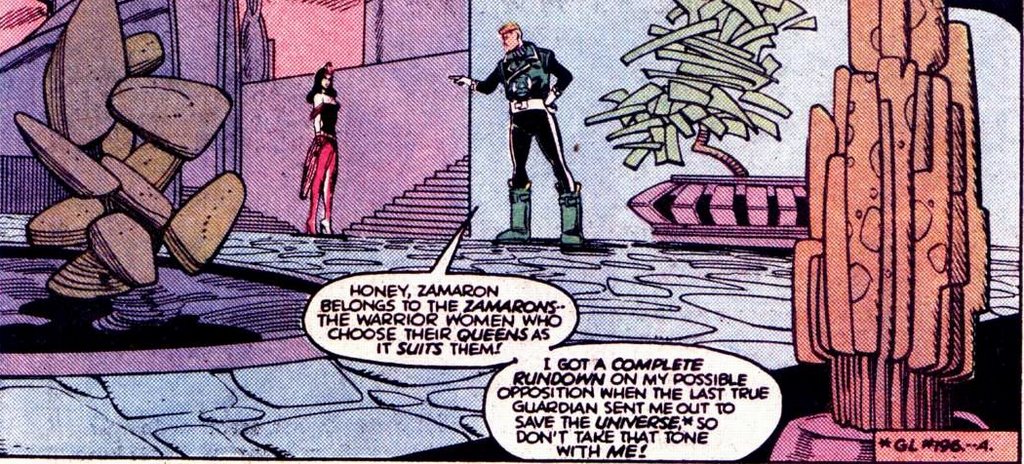
The Zamarons are my favorite alien race in the DCU. They look like human women, and dress in Ancient Greek armor, because that is dramatic shorthand for Dominant Women. Culturally, all of the stereotypes traditionally assigned by our society to men, are traditionally assigned to women on Zamaron. The Masculinist movement (in fact, the only resident male ever seen on Silver Age Zamaron was dressed in medeval garb) has never started there, so these women are all still gloriously chauvinistic neanderthals. As extremely weird customs go, they have a doozy. The Zamarons are all immortal and ageless (The Only Resident Male Ever Seen on Silver Age Zamaron was an elderly man, but later issues revealed that the Zamarons are an all-female tribe who split from their mates and any males on the planet are displaced from their native world) except for their Queen, Star Sapphire. Their Queen is always an alien, an exact physical duplicate of her predecessor. I'm sure there's a heroic, touching story of the original Queen making a sacrifice for her people and a decision to honor her in a ceremonial manner, but to my knowledge it has never been written.


I love this species, mainly because I have a thing for stereotype-reversals. The masculine of their species are the Guardians of the Universe (Green Lantern's alien bosses) and the Controllers (also recurring antagonists, but much more malicious than their feminine counterparts), both tribes of males value cerebral ability and personal inactivity/distance, downplays individuality, but dearly love to stick their nose in other people's business. Both male tribes have formed and managed Universal Police Forces. The Guardians created the Manhunters, then the Green Lantern Corps, and the Controllers managed the Manhunters and managed the Darkstars. The female tribe of the species values physical ability and personal achievement, but are considerably more reclusive. They only show up when they need a new Queen.

Their Queen is called Star Sapphire, and it's presumably been a successful weird custom when they look anywhere but Earth. They generally use some sort of mystic mental control whenever they appoint a Star Sapphire. Each of the women has been a bit different, so I wouldn't call it a complete take-over by an alien entity. I suspect it's closer to the personality of the Queen merges with the personality of the host. On Earth, this leads to trouble. It's probably a cultural thing.


Notable Star Sapphires in Earth History:


Star Sapphire I: Profiled in detail here, all you really need to know about this nameless classic Flash rogue (one of two females in the Golden Age Rogue's Gallery) is that she lived in the 7th dimension, was apparently kicked off of Zamaron for incompetence, and spent the remainder of her years fighting Golden Ager Flash Jay Garrick. As I gather, he never actually defeated her, she managed to do all of the work for him. I'm slow on my actual Golden-Age Flash reading (we're still waiting for the first appearance of the Shade to get archived), so I don't know much about this character firsthand. She sounds like your average cosmic despot, only her oppressed people were strong enough to give her the boot. Score one for Matriarchal Alien societies.

As female villains go, she represents the Megalomaniacal Matriarchist. Basically, she figured women should rule over men and she should rule over everyone. Basically, she's a gender-inverse of your typical Magalomaniacal Conquerer male villain (DOOM!), who back then often agreed with the hero that the men should rule over women, but always added the "and I should rule over everyone!" to the end.


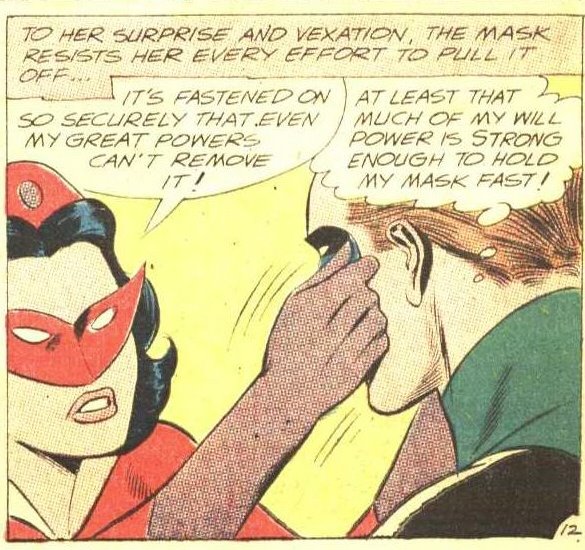
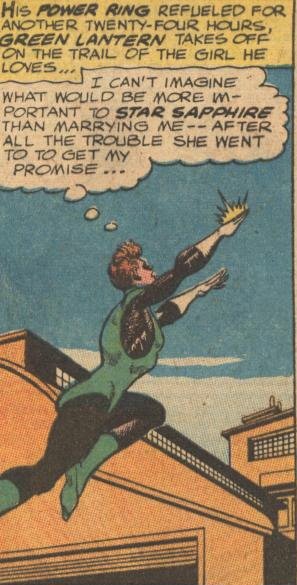
Star Sapphire II: Green Lantern's nightmare ex-girlfriend. Except, she was also his girlfriend. See, when Carol Ferris got a promotion at work, she dumped her boyfriend Hal Jordan because he was now a subordinate. The day before this happened, he had become a superhero. So, how did Green Lantern deal with being dumped on the eve of his superhero career? He started to date her in his superhero identity (without even trying to change up his personality or dancing style to throw her off). Hilarity ensued, as he spent half of his time with her thinking about how much he'd like to marry her, and the other half trying to keep her from asking him to marry her (as Carol was one of those progressive career women who would propose herself). Because he wanted to marry her as Hal Jordan, not Green Lantern. Ahhh, Silver Age Secret Identity Shenanigans. How many fine single-issue stories have you given us? Things continued with poor Carol as the underdog until the Zamarons came along and evened the score. Unfortunately, they forgot to tell Carol, and after every adventure as Star Sapphire, she forgot what's she'd been doing the entire time. She and Green Lantern were engaged for at least fifty issues without her ever knowing. It made for some wonderful "Courtship in Spaaaaace!!" type stories.


She was actually a very competent and viable threat to Green Lantern. In the first story, she very clearly did not want to win and was being forced to fight. She lost. Her second appearance, she competed with Green Lantern to see who could be the better superhero, with a trip to the altar as the prize. She won, but a fortunate bout of amnesia saved her from a lifetime of being Mrs. Hal Jordan. From that point on, every time she showed up she made reference to the impending marrige, but somehow always managed to be an antagonist. She's always proven a match on the battlefield, and at least once she stood toe-to-toe with Green Lantern UberNemesis Sinestro, the first and last time the two tried to work together. Her most villainous act was the kill Katma Tui in the ten most misogynistic pages in Green Lantern history. I've heard she was under mind-control by a male villain at the time, which actually makes it a lot worse.

Hal was more than willing to marry her, but somehow this relationship always fell through. Carol hasn't shown in up since Rebirth. She hasn't been Star Sapphire since before Hal caught that Giant Yellow Bug (from Outer Spaaace!!). She hasn't been a viable love interest since her marriage to cipher Gil Johns. Overall, she's the been the best Star Sapphire and the best love interest for Hal Jordan, and I very much want to see her back in those roles. And I know I'm not the only one.

Star Sapphire III: Dela Pharon. She showed up for one issue, and attempted to trick Hal Jordan into marrying her. That should give you an accurate assessment of her intelligence right there.

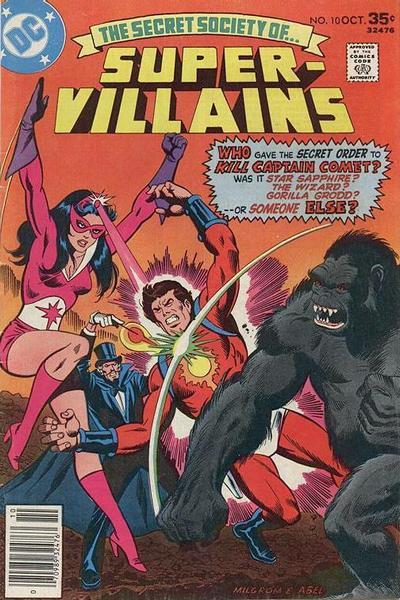
Star Sapphire IV: Debbie Camille Darnell. Debbie was introduced in the Secret Society of Supervillains, so I don't know too much about her (issues of that series are hard to come by in these parts) except that she never appeared after the series except in the recent JLA arc (Crisis of Conscience) with the rest of the old SSoSV. This tells me that she needs at least 6 men backing her up at every move, and is therefore a useless character.


She is the one who appeared in Infinite Crisis #6 on Wednesday, and it was revealed to me there that she was of the "Man-hater" type of Supervillainess. I see no usefulness in that sort of Supervillainess myself. I much prefer the subtle misandry desplayed by female chauvinism that's inherent in the Zamaron culture. It's a mirror to our own, and makes for much more compelling social commentary (compare to misogyny via chauvinism in our own culture) than "I hate men, so I'd like to kill Green Lantern." Hopefully, we'll get Carol back soon.

Wednesday, April 05, 2006

Carnival of Feminists XII

Greetings Earthlings, I am Star Sapphire, Sovereign of the Planet Zamaron, President of Ferris Aircraft, Super-Villainess, Much Maligned Strawfeminist, Recurring Green Lantern Antagonist, the Killer of Katma Tui, and, in the Grand Tradition of Supervillains Commandeering Comic-Book Blogs, your Guest Blogger for this evening. In a new twist, this was not a hostile takeover of this webspace, but I was actually invited to Host this, the Twelfth Carnival of Feminists, as Ragnell found the preparation too intense and Wonder Wimp--err, Wonder Woman couldn't make it. There was a slight problem with the Duke of Deception and apparently it could not be put off. In fact, they both insisted that I had do this before my wedding.


I have a superhero waiting at the altar right now, so let's get this show on the road.

Click Here for the Carnival

The first category offered was Influences. The hope here was for "posts identifying the attitudes and ideas that we are exposed to growing up, the things that shape who we are and what we think, and pinpoint the effect on how women are seen in society." Hmmph. Why didn't the silly woman say that in one of the calls for submissions?

Either way, the first post tells us the real reason Wonder Woman wimped out of this. Andrea offers a cutting image analysis, using the picture that accompanied the first submissions call for this very carnival. She examines how, even when she is not supposed to be sexualized at all, Diana is still specifically posed to entice male readers. I'm planning on stealing that last photo manipulation for the next time we fight the Justice League.

In a very tongue-in-cheek post, Jake considers what a young child may learn about women from reading Silver Age Supergirl Comics. If actually fighting the "Maid of Might" counts for anything, you can add my word to his on this subject.

Allison goes in-depth on the Duke Rape case, the offenders, and the permissive judicial system that enabled this to happen. For those of you who have been off-world, under mind-control, time-travelling, visiting an isolated society, in deep meditation, dead, or otherwise pre-occupied during the past two weeks, there is a blog created that follows the tragedy in its entirety, Justice 4 Two Sisters, so that you can catch up.

Verbify on Signifying Nothing shares a discussion on what makes a television character seem real to the audience. Is it true that the criteria for relatability is different on this planet because of gender?

Lucy, who's own words are far better than mine, gives us the "tale of an ogre - that would be me - who is uncomfortably roped into a world where she is expected to do tasks with delicate little fingers that she doesn't have; and to master assignments with strength that's already sapped."

Heart at Women's Space ponders breasts -- Real Breasts, fake breasts, and the effect that the obsessive oversaturation of Barbie-doll hotness has on Earth-women.

I see I'm not the only one unable to escape "raunch culture." If you think your teenagers are dressing too trashy, you should see what a Supervillainess is expected to wear. There's a large amount of criticism for this culture, but Natalie cautions against criticizing women for their personal clothing choices.

RJ, at Bark/Bite considers the symbolism of the Ooompa-Loompas in Charlie and the Chocolate Factory, and what it implies about women in American society.

From there we travel back to the familiar ground of comic books, and what red hair signifies in a female character, at Redhead Fangirl.

On the Big Monkey Comics, Sherin wonders if sexuality or sexiness diminishes respect for female characters overall.

Aditya discusses rape, religion, and Garth Ennis' Hellblazer at Dog Day Afternoons.

The second category is Inspirations, and it turns out surprisingly few of you were given powers by alien matriarchies. Instead, other women, from Earth, seem to have influenced you to action. I never imagined such a thing!

Professor Pideritt compares Kim Possible to Wonder Woman, and asks if children's programming has made any progress in the past thirty years. Tackling much the same subject, Kalinara feels that He-Man and the Masters of the Universe raised the bar for portraying women in 80s children's programming.

100LittleDolls searches for progressive role-models in pop culture, and initially seemed to have found one, but wonders if sexualization counteracts the strength in this case.

The Concoction brings us news from Zambia, where women are actively taking part in politics and encouraging others to do so. Fikirte hopes that women in the United States will follow their example.

Deepa tells us about being interviewed by a class of young children in Kerala, the heartwrenching story of a young girl in that class, and the effect on her life.

A White Bear, guest-blogging for Bitch Ph.d, relates the surprising inspiration that brought her to Feminism, and in the commentary, readers share their own.

Cultural Reversal seems to be the most vague category offered up, and she doesn't clarify it for me in the program. Personally, I am fond of the Cultural Reversals that involve trading stereotypes to make a point about the silliness of stereotypes or trading up situations that traditionally involve one gender or another. It may refer to the slow backward trend that starts when we stop pushing for progress (as experienced recently in a backlash against masculinism on Zamaron), or a call to reverse the negative aspects of the Culture with positive action.

Mary Ann of Five Wells describes the male reactions to Mathmetician Sophie Germain, when they realized she was a woman.

Laura at Geeky Mom considers the negative implications of the word "Mom," how it reflects on her own identity, and resolves to reclaim the term as a positive name. Ragnell (owner of this very blog) is also interested in the negative aspects of language, and the label "Fangirl."

In the comic book world, analyzing Vampirella for offensive content is considered akin to using a four million dollar research grant to determine whether or not mice get scared by cats, so no one has ever bothered before. But Dan has found an essay by Andrea Dworkin which identified the precise problem with the closest thing the mainstream comic industry has to actual pornography, how what apparently stops it from "crossing the line" in fact makes it worse, and pounds out an overall worthwhile commentary on the portrayal of women in comics that has some fresh insights into the awfulness of Vampirella.

"Just when I thought I'll fill my blog with light, frivolous and cutesy, what-did-I-eat-for-brunch-and-other-enlightening-titbits-of-my-life kinda posts," Megha rants, "something comes along and schlep's me back into reality."

Uma is furious with the audacity shown when a woman gets shot from trying to stop street harassment.

Bumblebee Sweet Potato covers the modern woman's obsession with dieting, the reasoning behind it, the surprising mental strengths it makes visible, and what we could do if we focused our energy elsewhere.

Frankengirl ponders the value of common advice to "write what you know," and how limiting it is to women writers. I understand completely. My own autobiographical attempt had to be rescripted as a comic book before it was released, heavily edited.

Melchior had a mixed reaction to X-Factor #5, caused by the disturbing images found within the comic book (that he's reproduced within the post). He reexamines the images, asking, "While it's clear that Peter A. David wants to subvert the sexist trope of the woman who needs a man to deliver her from a dangerous situation, does he succeed?

"Birth seems to be ignored as a feminist issue among the blogs that I've been seeing," Tina the Radical Feminist Mom worries, "Lots of stuff about reproductive rights, whether or not to have a baby, but nothing about the feminist ramifications of how one actually has a baby." Hey look, at the bottom there's a bullet-point outline of the maternity/nursing culture they have on Zamaron. Yeah, I'll be having my baby there.

Artemis has been watching women fight other women. "And I'm sick of it," she says, "Sick of women tearing me down. Get it together sisters." Meanwhile, Super Babymama (I wonder if she's related to that jerk in Metropolis) dreams about being a better feminist than anyone else.

AfroFeminista saw dancing on International Women's Day, which revealed a mixed messages for the young girls in the dance group. "To what extent" she asks, "should the feminist movement especially that populated by younger women, embrace and give space to these sort of expressions - be they art, dance or written word?"

A street poll conducted by a South African newspaper about a politician who is on trial for rape recorded some horrifying attitudes towards the accuser, and in response GGernst says it's time for women to start decolonizing their minds.

Femme Feral hits upon another evil of Reality TV, which has done more harm to society than the entire Legion of Doom (not counting Lex Luthor, who has a producer credit on Trading Sidekicks). She writes about the misogyny in Real Housewives of Orange County, a show that seems specifically designed to make you hate women.

And then the catch-all category of Other, in case of submissions that didn't quite fit the rest.

Leisha experiences the reopening of old wounds, and realizes that "healing a wounded soul is never a finished task."

When the British Royal Couple visited Saudi Arabia, it seems that Camilla was given "honorary man" status, as evidenced by her wardrobe when compared to what Saudi women are permitted to wear.

Emma finds an article on Feminist bloggers, who they represent and what value they actually are to the Feminist movement at large.

Muse at Me-ander rants about how people treat her as opposed to how they treat her husband.

Debbie and Laurie have discovered a brand new species of Strawfeminist! The Attention Stealer.

A new women's poetry blog, Womb Poetry, is now accepting submissions.

And finally, "My Head's Not Worth Stink" from Dementia Blues, which was among the first submissions. Ragnell notes that she intended to include it, but didn't notice the date until today. Because it was her own mistake, she's including the older post anyway.

There is plenty more reading at the Third Radical Women of Color Carnival, up at Blac(k)ademic right now.

And that's that. Ragnell would like me to thank everyone who submitted, and everyone for visiting, and to inform you that the next Carnival will be on I See Invisible People on April 19. Terry has the info up here.

I'm very happy to have had the opportunity to do this, and to see all of the submissions from the various blogs. I really wasn't aware of so many. I'm going to stick around and look through some of them (Ragnell should be back to blogging tomorrow), see if there's any advice for a newlyweds.

With much more gratitude than I'd expected,
-- Star Sapphire


Two Weeks Later...

Tuesday, April 04, 2006

Another Blogiversay

Didn't get a chance to check it out yesterday, but Ferret Press/Panel Weblog is now three years old. They're doing a week-long celebration with a lot of posting, and even offering free shipping for their orders this week. Drop by and wish them a Happy Anniversary.

Fan-What?

There's a conversation going on over at The Absorbascon about the Justice League, and what power combination a composite super-villain would need to beat them singlehandedly. To me, it's a given that all the villain needs is above average intelligence and the Flash's powers. You see, I've thought a lot about this. I've argued it in the LCS. I've used this to make a good case for why any one of Flash's seemingly incompetent Rogues' Gallery members should be able to wipe the floor with any entire team of heroes sans speedster.

This reminded me of a conversation Kalinara and I had yesterday that has me musing on the term "fangirl" today. It's a linguistic issue, mainly. In theory, Fanboy and Fangirl are simply gendered terms to differentiate a male fan and a female fan. In practical use, they have not only a different gender but an entirely different meaning.

Internerd Fan-Fiction is believed to be dominated by women. Particularly Slash Gay Fanfic (but really, how could we tell?). It's also widely accepted that Manga is more popular among female readers. There's enough of a stereotype that combines the definition of traditional femininity, the connotation of "girl" and the idiosyncrasies of fandom to get a very clear picture from the word. It conjures an image of blonde pigtails, a Sailor Moon costume, an armful of pink-covered Manga books and a notebook filled with ruminations on the romantic entanglements of dark, moody, brooding male characters. She's excited by the idea of two gay men not because it affords the opportunity to appreciate the male form, but instead because it showcases two males in a loving, caring relationship. Oh, and she can't get enough of The Angst, it has to do with all those afternoon soap operas she watched with Mama.

There's a mood associated with Fangirl, just as there is a mood associated with Fanboy. The mood associated with Fanboys is that of dimly lit comic book stores, with a table set aside for the Saturday Night D&D game, dark blue/black T-shirts with superhero logos/smartass phrases ("C:/DOS C:/DOS/RUN RUN/DOS/RUN"), an argument about whether the Hulk or Superman would win in a fight, wacky crossover ideas, lifesize cardboard cutouts of Lara Croft, and round the clock internet access. Gay or Straight, he wants to cut the Angst and get on with the Action, he feels the best reason for cheesecake and sexually explicit scenes is the titillating view it offers, and he just giggled at the first syllable in the word "titillating."

Fanboy is a "Blue" term, as in "Blue is for Boys." Whereas, Fangirl is a "Pink" term, as in "Pink is for Girls." There is nothing inherently wrong with blue or pink. Both are fine colors, moods, acceptable lifestyles. But these colors represent traditional gender roles. The pink term of Fangirl embraces traditionally feminine traits like emotional/romantic thinking, pastel colors, cutesy things, and an audible high-pitched squeal associated with hearing about an opportunity to meet David Cassidy. The blue term of Fanboy embraces traditionally masculine traits like logical/statistical thinking, primary colors, blood and gore, and manly grunting/deep voiced "oh yeah"s.

I'm becoming increasingly uncomfortable with the term "Fangirl" -- mainly because I'm not fitting the stereotyped role very well. I'm not a big fan of angst. Not the long drawn out kind. One story of angst, okay, but on the whole I prefer to cut it short and get with the action. I've never been able to get into Manga. As fun as it is to make jokes about homoerotic content in the actual comic, I'd prefer not to read or write an entire fanfic about the encounter. I cheered on Obsidian's coming out partially because it offered a chance to see him in bed with a particularly handsome backup character, but mostly because it put an end to the Constant Angst that was Todd Rice's Personality. A lot of crap can be blamed on repression in this case.

Basically, I, and most of the fans I associate with (of either gender) are a mixture of both types, but leaning towards the "Fanboy."

And none of this occurred to me until yesterday, when we crossed the line. As usual, we were discussing Green Lantern. I'm not sure why the idea came about, but it did, and I asked Kalinara would would win if Guy Gardner (as Warrior, who was basically a shapeshifting Superman with energy blasts) fought Kyle Rayner (as Ion -- not the omnipotent version, but the upcoming somewhat-more-powerful-than-a-Lantern version). I said Kyle and she said Guy. We then proceeded to lay out the circumstances of battle, and hammer out a chart which stated who would win under what conditions, after discussing the planning and combat abilities of each characters.

During the entire conversation, we never once discussed whether they would kiss, or feel bad about the battle afterwards, or even if their clothes would be torn off. Once we'd ironed out the winner in each circumstance, Kalinara remarked that we'd given up female status on this one. I laughed then.

Unfortunately, it's not so funny when you think about it.

Sunday, April 02, 2006

Posture Perfect

I was going to agree with the anonymous commenter on Katma's pose in my last post, until I found this picture.


Unfortunately, panels like this are few and far between. Usually, the poses are reversed.

The problem with female poses...

I'm actually a big fan of reasonable cheesecake in comics. So long as the art is well-done, and there's something in it for me. Unfortunately, Equal Sights will elude us as long as sexuality overtakes practicality. When learning to draw in comics, certain poses are the first you work on. Those become the default pose. The default posing for women emphasizes the hips and breasts as much as possible. It makes it easy to tell at first glance the gender of the character. This combines with the natural "Prettying up" of the art to make an appealing cheesecakey pose for the cheracter. The "Sexy Woman" pose becomes "Comics Shorthand for Girl." It's just easier to draw that way. Drawing a character to be appealing makes sense. The problem inherent in this is what kind of pose is considered appealing. More specifically, the problem is what kind of pose is considered appealing for each gender, as Male and Female characters are usually drawn with different posture as part of the "comics shorthand" for their gender.

Yes, everyone in comics gets sexualized. But the men (Once again, note Hal's pose, this time at right) get to stand tall and strong and practical and still be considered desirable, while the women look as impractical as possible. This is because of that "shorthand for girl" learning. It drives me out of my mind to see martial artists and experienced fighters in comics, standing with their backs arched, their breasts up, and their butts back, messing with their center of gravity and their final health when they should certainly know better. The better fighting position has your feet shoulder width apart and your spine straight.

To illustrate this, I was going to use the Phantom Lady S-Spine of Torment and Triple-D-Cup of Doom combination, but I didn't want to cause any physical trauma from the sheer awfulness of it. Here's a much more palatable example:


There is no reason Black firkin' Canary, one of the Top Ten Martial Artists in the DCU should be anticipating an attack with her heels together and her hip tilted suggestively upward. I don't know Judo specifically (so, please correct me if I'm wrong), but I do know that's a way to get seriously hurt.

Now, the above panel was rendered by Our Beloved Neal Adams, Wielder of Symbolism, Master of Visual Characterization, Patron Diety of Facial Expressions. As a fan of his, I'm inclined to give him the benefit of the doubt. She's at a relaxed position, and just now getting into the stance as she sees the attacker.

Except for one problem, a woman who spends as much time fighting as Canary does would not have such as vulnerable posture as her "Default stance." She would naturally use something more in keeping with her training.

I took a couple years of Karate in high school, and during this I started unconciously adapting the stance in my everyday stuff. I kept my spine was usually straight and my feet shoulder-width everywhere I stood. It had the effect of sticking my belly out, and tucking my butt underneath my spine. I'm naturally top-heavy, so my butt effectively disappeared. A year or two after I'd been to my last class, I noticed my friend Liz was constantly flirted with, by the guys I liked. I asked about it, and she advised me to stand more suggestively. Stick my butt out, angle my stomach in, and arch my back so as to emphasize my breasts. It was quite a change in posture, but I tried it and it took.

None of those men were worth the trouble, and by the time I learned that I'd adopted the posture into my natural habits and didn't feel it was worth changing back.

Until the back problems started. They are still there. My Doctor prescribed two sets of medication, which didn't work, before he gave me a sheet of annoying exercises I now have to accomplish every day. I also have a seventy-five dollar back brace that I need to use occasionally. It's only a mild problem right now, but it still keeps me awake sometimes, and it makes working difficult on the bad days. And according to my doctor, it's because of my posture combined with my chest.

Now, as as Chris kindly pointed out, this was thirty years ago and Adams was just learning to handle martial artists. Canary's posture got better as the series moved on. More than likely, he needed an at rest pose and used a picture of a woman standing like that. This would be all well and good, if it weren't for the fact that artists still do this. Models still do this. Television stars still do this. The "Sexy woman pose" is one that we all learn and internalize as little girls. This is what a pretty lady stands like.

She stands with her chest out, her back arched, her legs together, and her center of gravity compromised.

She stands in the most vulnerable position possible, the one from which it is the most difficult to prevent an attack.

She stands in the posture most likely to cause major back problems in a few years.

But hey, it's hot, right?

Final Call for Carnival of Feminists XII Submissions

Everyone, you have until midnight April 3rd CST to send in your last-minute submissions for the Carnival of Feminists. See the First Call for the details. You can still use the Blog Carnival Submission Form (Warning: right now it's set right now for a early submission deadline of midnight, April 2nd GMT; I've emailed them to change that but y'know how that works on a weekend) or you can email me directly at ragnellthefoul AT gmail DOT com.

The Final Call's featured image is the first in-story appearance of Katma Tui circa 1964. Katma's special because she was the first female Green Lantern character who was not a villainess and/or somebody's girlfriend. She was a co-worker.


She died a pointless misogynistic death in Action Comics Weekly #601 in 1988, and was resurrected for three issues in 1993, which just about every writers at DC has forgotten. I've got my fingers crossed, though, since nearly everyone else in that franchise is returning from the dead.

Saturday, April 01, 2006

Hal and the Guardian


I see nothing important or meaningful in this panel.

(Update: April 2, 2006 -- Ragnell the Fair and the rest of her Bizarro compatriots have been overthrown. I haven't saved any evidence of her work, as it made my eyes bleed. A Jade profile picture? *Shudder* Anyway, I don't have time to get into this panel at the moment, but I assure you I will be contemplating it)

Friday, March 31, 2006

And Now For Something Completely Insensitive...

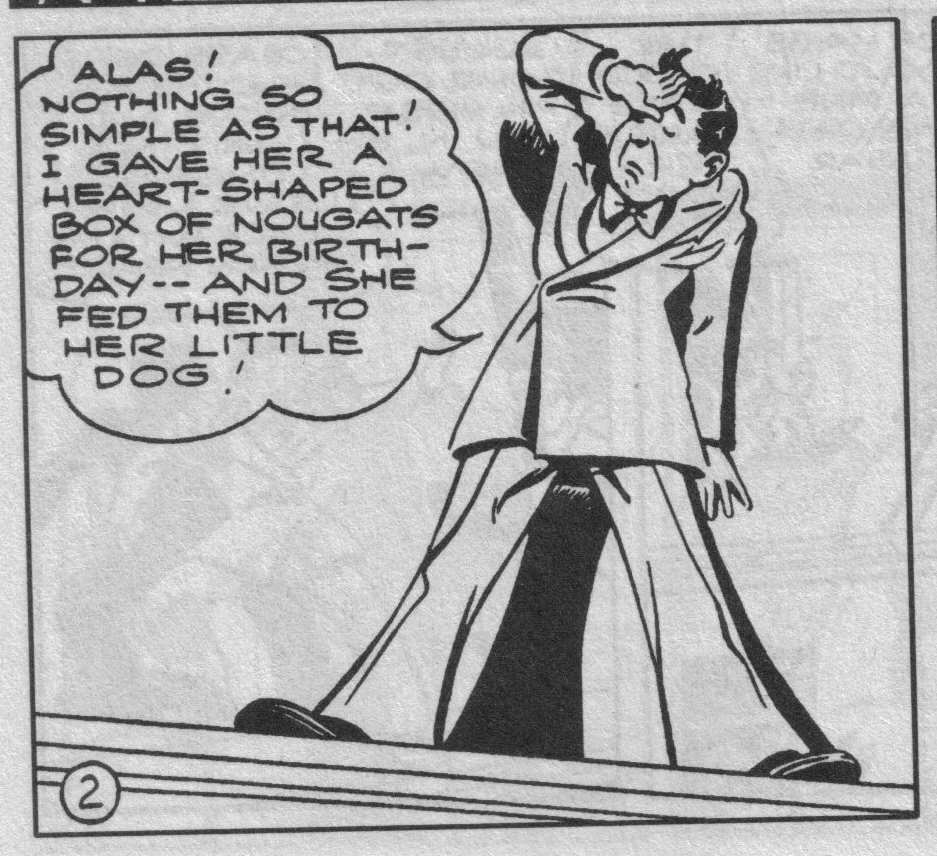
I cheated, I peeked ahead in the Showcase Presents: Superman Family volume. I read the very last story before I read the middle. I had to, it was a 1944 Lois Lane solo story. It was great, though. Lois sets out to prove she can get a story without Superman hovering nearby. She goes to a downtown building, and sees a jumper on the ledge. She actually volunteers to go out onto the ledge herself and talk him in. (And the featured cops actually let her)

Anyway, things go wonderfully until she asks why he's jumping. It's over his girlfriend.


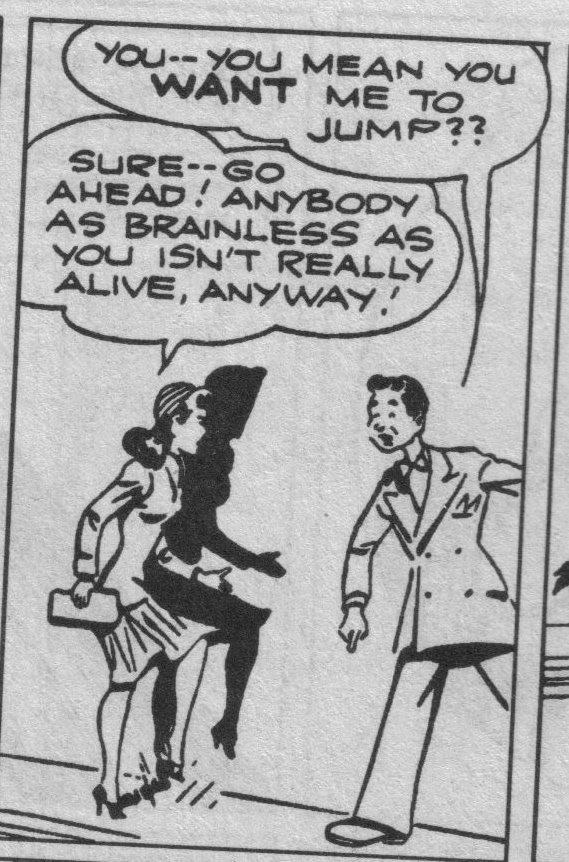
Now, if you're Lois Lane, and you hear the above as a reason to jump off a building, how do you respond?

A -- "You poor thing! You certainly need to talk to someone about this. If you'll come in off the ledge, I know a fine couples counselor who can get to the bottom of your troubles."

B -- "Did you think that maybe she wanted to keep her slender, delicate figure for the sake of your eyes?"

C -- "Why, you grade-A boob, you! Do you mean to say you'd jump eight stories over a thing like that?!?"

For our answer, let's take a look at the panel after Lois' response.


And there you have it folks:
Lois Lane, Emergency Counselor for Troubled Young Men.


Who else wants to be her when they grow up?

Thursday, March 30, 2006

WTF?


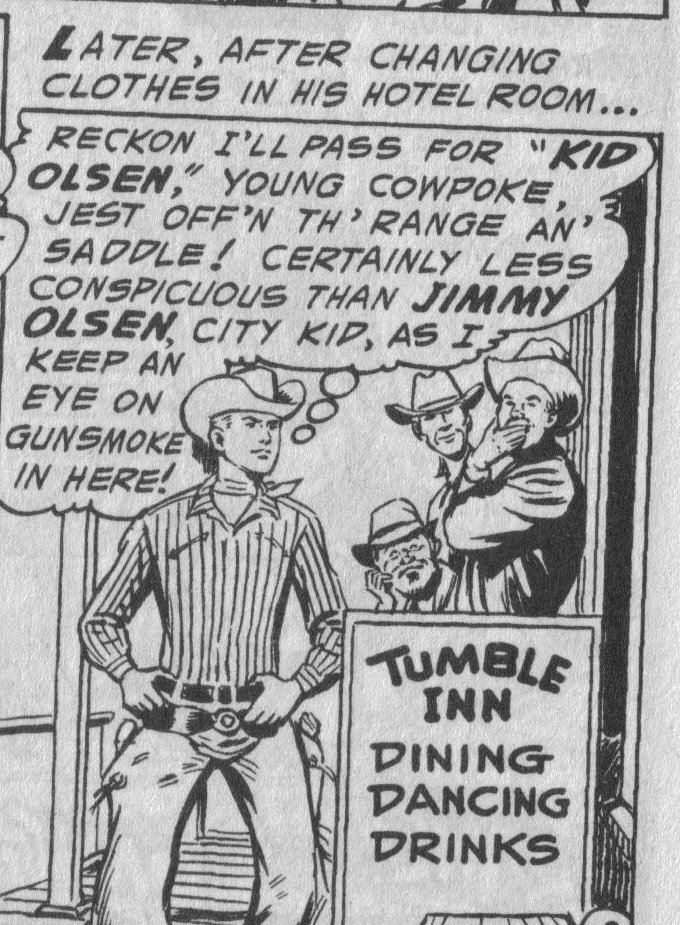
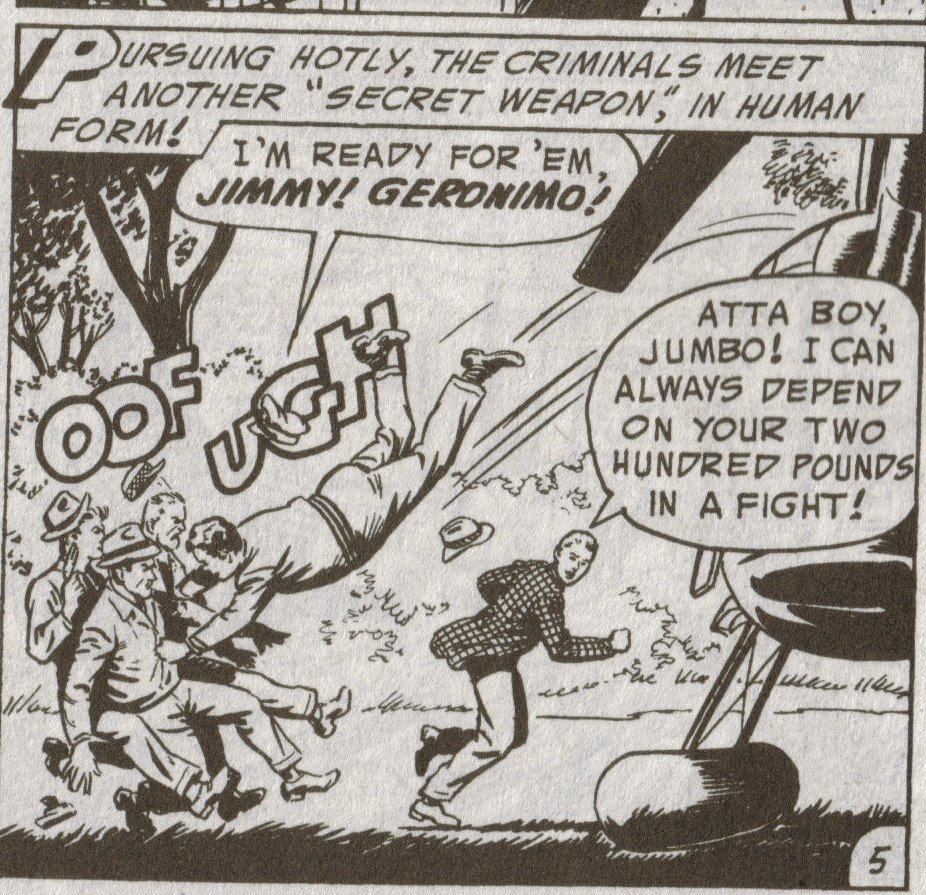
The character of Jumbo Jones is jumping into the fight on Jimmy's signal and yelling something stupid. Jimmy compliments him about how he can always count on him in a fight. He has a useful transportation job (pilots the Daily Planet's Helicopter).

I've read six stories of Showcase Presents: Superman Family and he's in three of them.

How in the hell did Jimmy Firkin' Olsen get a sidekick?

Wednesday, March 29, 2006

Second Call for Submissions to Carnival of Feminists

Here's your friendly reminder that the deadline for the Twelfth Carnival of Feminists is Monday, April 3rd. With respect to previous objections, I'm reluctant to take unsubmitted posts (though I have seen a number of good ones). I urge you to take advantage of e-mail, the Carnival Submissions Form, and the Technorati Tag (don't forget to ping Technorati after you do so).

My first submissions call led to a wonderful disagreement, completely by accident. Such an excellent accident I couldn't dream of recreating it, so instead, I'm simply going to load an example of truly, truly, awful art (Found via Resplendant Beard, courtesy Newsarama) and see what you have to say.

This is not an attempt to convince anyone they overreacted to the first picture (I haven't seen anyone who has). It's more to give you an idea of the scale the dissenting regulars are operating on. (And my earlier offer stands for this image too)

I must warn you, if you find Truly Awful Art (TAA) traumatic, you may want to avoid this cut. (And don't worry, the body of the Carnival itself will be free of anything so hideous -- and I'll post warnings on the links) Instead, here's an index of Neal Adams covers to peruse.

Be Warned: This is Beyond T&A...(You can click on the picture, if you can stand enlarging it)

Monday, March 27, 2006

Exit Page Left

(Because I haven't done a Neal Adams panel for a while now...)


Click to Read (Yes, it's that long)


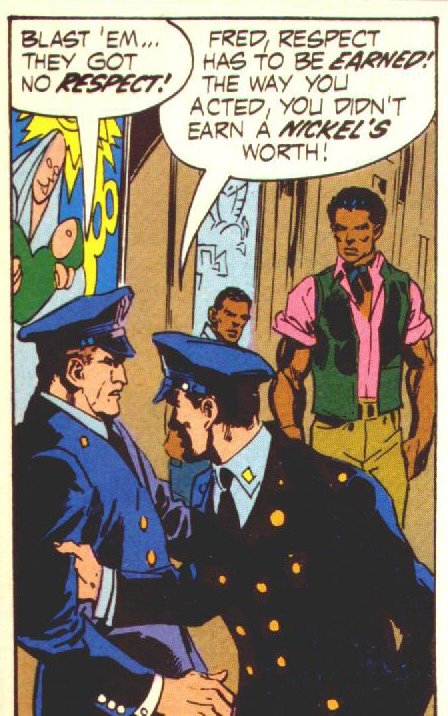
I've been looking at this one for a while now. Initially, I noticed one thing. That Fred's partner, the Good Cop, is pulling Fred back to the spot underneath the halo.

There's also something suggestive about Fred's posture. The profile and the way his neck and head are situated as he says "They got no respect!" reminds me of the sort of villain that Green Arrow is constantly complaining about. The man who doesn't care about anyone but himself and who will step on the backs of the poor and the oppressed to climb into the next higher tax bracket. This guy shows up in nearly every storyline in the ONeil/Adams run. He's usually highly placed in some organization, with lots of underlings he can abuse. Usually, he's brought down because he arrogantly thinks he can manipulate, intimidate or overpower one of the heroes. He comes back within a storyline or two. Different name, slightly changed appearance, but his attitude and posture remain the same. This cop isn't him, but this cop is obviously training to be him unless his partner can keep him reigned in.

(I suspect, however, that he grew a moustache, let his hair go gray and showed up in Nextwave #3 this week, so his partner obviously couldn't handle him)

His partner's face is still shadowed, like it was in the first panel. Fred gets a name, but he doesn't. There are some good reasons to keep him anonymous, actually. Even if John did manage to beat the living daylights, unarmed, out of the armed cop (given that John is the Hero in the story, I wouldn't count this option out) he was still in for a boatload of trouble for it. That was the way of the day. The Good Cop helps him out of it (even though he was unwilling to intervene at the first injustice, when the threat of actual physical violence is present he has enough decency to step in). Keeping him anonymous lets John and the reader know not to expect a "return favor" claim on this act. I heard an adage once that the only true form of charity was done in secret, because that way there was no possible gain. This guy won't even claim a look or word of gratitude.

Two faceless, nameless policemen are symbolic of the police in any given Fictionopolis. In Gotham or Bludhaven, when you come across an unnamed cop (usually with a generic face), they tend to be a bad guy. The majority of cops in those two cities are corrupt. In Keystone, Metropolis, or Opal, an unnamed cop is there to help. By naming Fred and showing his face, he's singled out an individual. He no longer represents the police force in general. This lets you know that in John's hometown, despite the visible poverty, corruption on the police force is not overwhelming. By leaving the Good Cop anonymous, to the point where his face is even shadowed, he can represent every cop in the city. His actions here indicate that the majority of the cops are not guiltless -- they stand by in the face of many injustices -- but they still have it in them to stop a violent threat to the citizenry.

By obscuring the face and omitting the name of the cop, it also encourages reader identification with him. This is common in French Arthurian Romances, there are a number of female characters introduced to help the knight, btu they are never named. They did this because the majority of courtiers who read those romances were female, and a nameless hero's helper allowed them to project themselves into the story.

The last reason (and most likely) I can see to keep the Good Cop's face shrouded is to keep the overall focus on John. At this point in time, it was actually more likely that the Good Cop would end up being the hero than John. Not even showing us the guy's face keeps him in obscurity. There's no threat he'll be a major character or even return. He's a background character, through and through.

He takes the foreground here, though. He's leaning forward, expressing concern and interest. Like the madonna overlooking them in the mural, he's looking after his partner here. He's gently shepherding him out of a situation that will be bad for all involved.

Adams uses the normal artist technique of less detailed, less focused background so that the attention in the individual panel remains on the action. It saves him work, and it keeps the reader from getting lost in the details. As he does this, he manages to continue his characterization of John.

John stands steady, completely ready to defend himself. The lines on his face and arms take on a stony quality. You can tell this man is determined, firmly devoted to his ideals, and willing to stand up for himself. He's a very earthy, very steadfast, very solid person. John's special strength is just that, strength. Steady as a rock.

He's even positioned so that he's overlooking Fred. He's in the right, and winning.

Something about then character positioning and posture in this panel gives the impression of a moving foreground and still background. Part of it is John in relation to the cops. He's towering over them, more so than in the previous panels. It makes me think sidewalk is a downward slope in relation to where I'm standing, and that the cops are traveling down it. The lack of focus that gives John and the domino player such statue-like features helps by conveys stillness, compared to the policemen who are moving.

And how they are moving! To the left of the reader in a story that reads left to right. Fred backs reluctantly out of the panel. His partner is aggressively driving him back to the earlier pages. You can tell they won't be back, because they're not moving forward with the reader. This panel is in the bottom left of the page, there's nowhere else to follow them.

Yes, I do realize how silly that sounds, but it's an effective device. The reader gets the impression that following the cops would mean going back to the beginning of the story. John is the right-most character, the closest to the next sequential panel. He's the one to follow.

Quick Links

Go over to Dark Daughta's and read this. I don't care that it's not worksafe, read it.

Found via And We Shall March... -- The Calls of Cthulu!

Happy Blogiversary to The Absorbascon and Happy Belated Blogiversary to Shrub.com, which I don't link nearly enough to.

Michileen Martin needs your help. He's looking for books on the History of Superheroes for a college project.

Dark and Moody Chicks -- a comic strip/blog.

Blockade Boy turns his discerning eye to a Classic Flash Rogue.

Zombie Mallet's started up a second blog.

While there's never a shortage of Green Lantern posts, here's Kalinara on Fatherhood in the Green Lantern Mythos.

And older, but interesting discussion of hostile environments.

Shelly'll like this: The Fortress Keeper's been blogging about Supergirl for a week now.

And finally, get your Obsidian panels ready, April 22 is Blog Against Heteronormativity Day, started by Blac(k)ademic.

I've Been Out-Crazied

I've been in some interesting arguments as a Green Lantern fan. It's not all Hal vs. Kyle. Sometimes it's Kyle vs. Alan. Sometimes it's the worthiness of Jade. Lately it's been "Why do we never see John Stewart anymore?" which invariably leads into an argument about whether or not he actually has a personality (He does, dammit!). I've even been in a 9-page argument about a certain character's haircut. But this is the first one I've been forced to bow out of.

The Highlights


Original Poster (OP):
"My question to the GL creative teams ...Will we ever find out Sinestro's name before he turned against the GL? It doesn't make sense that he was a GL with a name like Sinestro."

Sensible Poster #1 (SP1): And his name being "Sinestro" means absolutely nothing. Just because "sinister" means something in our language doesn't mean it has the same definition in other language.

OP: (Ignores SP1 and latches onto other arguments) Everyone knows Sinestro was a GL gone bad. I'm just asking for his name during the time he was a GL. IMO it doesn't make sense to have an evil sounding name. It's like Anikin/Darth, Illyich/Lenin,Ioseb Jugashvili/Stalin etc...

SP2: Sinestro was his name when he was a GL. That's been clearly established. That it sounds "evil" to you is not his concern.

SP3: If you met someone named John Hitler, would you automatically label them as evil?

OP: There is a John Hitler and he lives on Long Island and he is related to Adolf Hitler. I wouldn't label him as evil but his surname will cause question and curiosities I wouldn't label him as evil but his surname will cause question and curiosities. I'm pretty sure that family has been investigated by CIA or FBI. It's just like the Bin Laden family in the USA. You know they are questioned for any thing dealing with Ossama. now the difference between names Sinestro, Bin Laden, Hitler or McVeigh are this.......Sinestro's,evil meaning, name was already associatted with evil before and after his rebellion. Now the names,none of evil or bad meaning, of Bin Laden, Hitler, and McVeigh became associatted with evil only after what they became known for in history.

Me: Well, on Korugar, the name Sinestro obviously wasn't associated with Evil until after Sinestro had become a Dictator.
How's this, suppose you know an American man who's last name is Malvado? He's not of Spanish, Italian or French ancestry. The original family name was corrupted by INS personnel when his family emigrated, because it was a difficult to pronounce Czech name. So now he has a name that means "Evildoer" in Spanish. But English-only speaking people in the US or Canada are not going to know that offhand, and they aren't going to associate his name with the term "Evildoer" when they meet him. Because they don't speak Spanish.
This is Sinestro on Korugar. His name is an accident, and on Korugar no one associates with "sinister" because in Korugarian there is no word "sinister" and Sinestro does not mean evil. It means or is derived from something like "Peaceful" or "Brave" or something equally innocent.
Now, when our Mr. Malvado goes to a mainly Spanish-speaking area in the US, or a Spanish-speaking country, he's going to get a lot of double-takes at his name. This is Sinestro when he got to Earth. By a linguistic accident, his name means something bad in another language.
It has no more to do with Sinestro going rogue than Mr. Malvado's name has to do with his jaywalking.

OP: Why would INS name a Czech Malvado?

Me: (after I'm finished banging my head against the keyboard) Okay, I'm done.