Thursday, March 30, 2006

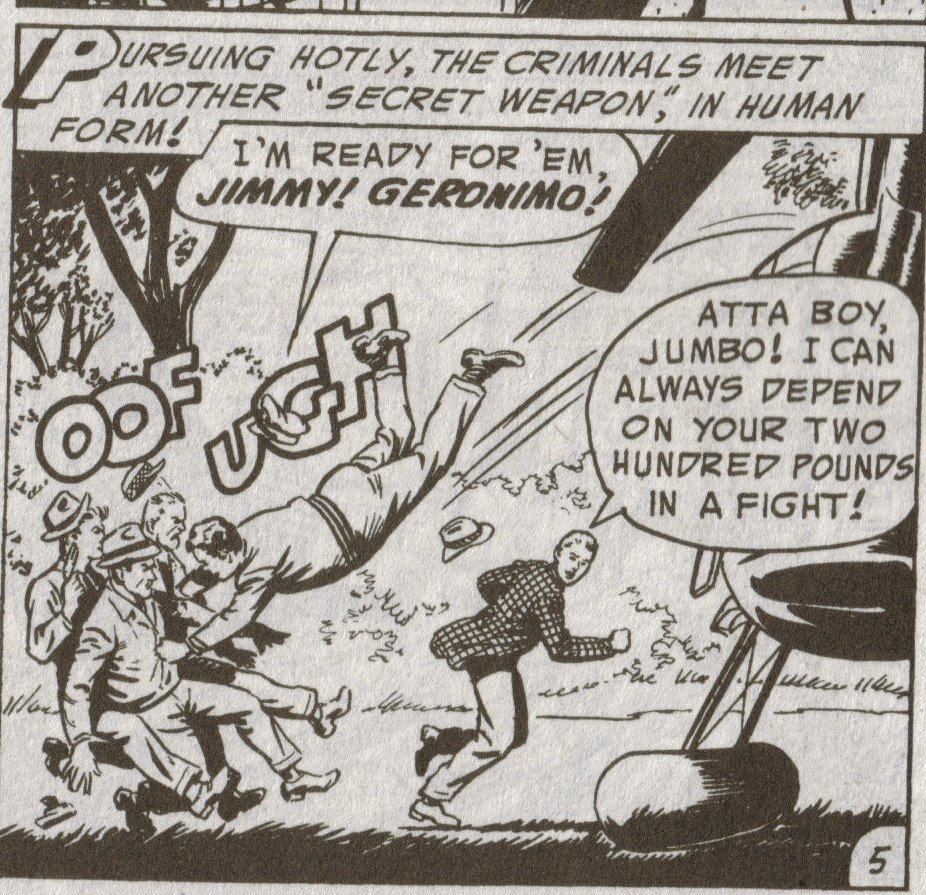
WTF?


The character of Jumbo Jones is jumping into the fight on Jimmy's signal and yelling something stupid. Jimmy compliments him about how he can always count on him in a fight. He has a useful transportation job (pilots the Daily Planet's Helicopter).

I've read six stories of Showcase Presents: Superman Family and he's in three of them.

How in the hell did Jimmy Firkin' Olsen get a sidekick?

Wednesday, March 29, 2006

Second Call for Submissions to Carnival of Feminists

Here's your friendly reminder that the deadline for the Twelfth Carnival of Feminists is Monday, April 3rd. With respect to previous objections, I'm reluctant to take unsubmitted posts (though I have seen a number of good ones). I urge you to take advantage of e-mail, the Carnival Submissions Form, and the Technorati Tag (don't forget to ping Technorati after you do so).

My first submissions call led to a wonderful disagreement, completely by accident. Such an excellent accident I couldn't dream of recreating it, so instead, I'm simply going to load an example of truly, truly, awful art (Found via Resplendant Beard, courtesy Newsarama) and see what you have to say.

This is not an attempt to convince anyone they overreacted to the first picture (I haven't seen anyone who has). It's more to give you an idea of the scale the dissenting regulars are operating on. (And my earlier offer stands for this image too)

I must warn you, if you find Truly Awful Art (TAA) traumatic, you may want to avoid this cut. (And don't worry, the body of the Carnival itself will be free of anything so hideous -- and I'll post warnings on the links) Instead, here's an index of Neal Adams covers to peruse.

Be Warned: This is Beyond T&A...(You can click on the picture, if you can stand enlarging it)
Monday, March 27, 2006

Exit Page Left

(Because I haven't done a Neal Adams panel for a while now...)


Click to Read (Yes, it's that long)


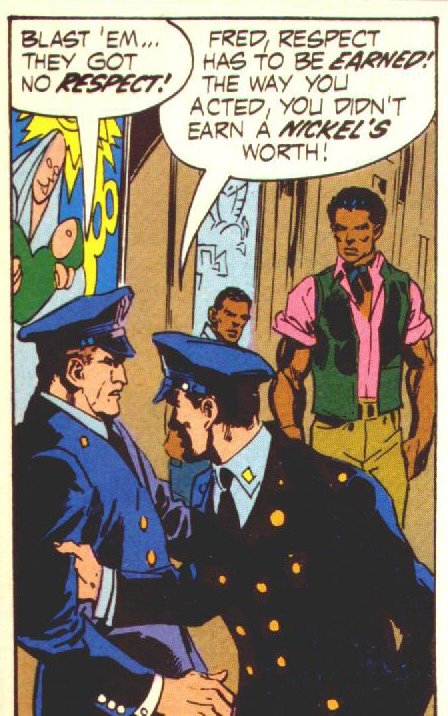
I've been looking at this one for a while now. Initially, I noticed one thing. That Fred's partner, the Good Cop, is pulling Fred back to the spot underneath the halo.

There's also something suggestive about Fred's posture. The profile and the way his neck and head are situated as he says "They got no respect!" reminds me of the sort of villain that Green Arrow is constantly complaining about. The man who doesn't care about anyone but himself and who will step on the backs of the poor and the oppressed to climb into the next higher tax bracket. This guy shows up in nearly every storyline in the ONeil/Adams run. He's usually highly placed in some organization, with lots of underlings he can abuse. Usually, he's brought down because he arrogantly thinks he can manipulate, intimidate or overpower one of the heroes. He comes back within a storyline or two. Different name, slightly changed appearance, but his attitude and posture remain the same. This cop isn't him, but this cop is obviously training to be him unless his partner can keep him reigned in.

(I suspect, however, that he grew a moustache, let his hair go gray and showed up in Nextwave #3 this week, so his partner obviously couldn't handle him)

His partner's face is still shadowed, like it was in the first panel. Fred gets a name, but he doesn't. There are some good reasons to keep him anonymous, actually. Even if John did manage to beat the living daylights, unarmed, out of the armed cop (given that John is the Hero in the story, I wouldn't count this option out) he was still in for a boatload of trouble for it. That was the way of the day. The Good Cop helps him out of it (even though he was unwilling to intervene at the first injustice, when the threat of actual physical violence is present he has enough decency to step in). Keeping him anonymous lets John and the reader know not to expect a "return favor" claim on this act. I heard an adage once that the only true form of charity was done in secret, because that way there was no possible gain. This guy won't even claim a look or word of gratitude.

Two faceless, nameless policemen are symbolic of the police in any given Fictionopolis. In Gotham or Bludhaven, when you come across an unnamed cop (usually with a generic face), they tend to be a bad guy. The majority of cops in those two cities are corrupt. In Keystone, Metropolis, or Opal, an unnamed cop is there to help. By naming Fred and showing his face, he's singled out an individual. He no longer represents the police force in general. This lets you know that in John's hometown, despite the visible poverty, corruption on the police force is not overwhelming. By leaving the Good Cop anonymous, to the point where his face is even shadowed, he can represent every cop in the city. His actions here indicate that the majority of the cops are not guiltless -- they stand by in the face of many injustices -- but they still have it in them to stop a violent threat to the citizenry.

By obscuring the face and omitting the name of the cop, it also encourages reader identification with him. This is common in French Arthurian Romances, there are a number of female characters introduced to help the knight, btu they are never named. They did this because the majority of courtiers who read those romances were female, and a nameless hero's helper allowed them to project themselves into the story.

The last reason (and most likely) I can see to keep the Good Cop's face shrouded is to keep the overall focus on John. At this point in time, it was actually more likely that the Good Cop would end up being the hero than John. Not even showing us the guy's face keeps him in obscurity. There's no threat he'll be a major character or even return. He's a background character, through and through.

He takes the foreground here, though. He's leaning forward, expressing concern and interest. Like the madonna overlooking them in the mural, he's looking after his partner here. He's gently shepherding him out of a situation that will be bad for all involved.

Adams uses the normal artist technique of less detailed, less focused background so that the attention in the individual panel remains on the action. It saves him work, and it keeps the reader from getting lost in the details. As he does this, he manages to continue his characterization of John.

John stands steady, completely ready to defend himself. The lines on his face and arms take on a stony quality. You can tell this man is determined, firmly devoted to his ideals, and willing to stand up for himself. He's a very earthy, very steadfast, very solid person. John's special strength is just that, strength. Steady as a rock.

He's even positioned so that he's overlooking Fred. He's in the right, and winning.

Something about then character positioning and posture in this panel gives the impression of a moving foreground and still background. Part of it is John in relation to the cops. He's towering over them, more so than in the previous panels. It makes me think sidewalk is a downward slope in relation to where I'm standing, and that the cops are traveling down it. The lack of focus that gives John and the domino player such statue-like features helps by conveys stillness, compared to the policemen who are moving.

And how they are moving! To the left of the reader in a story that reads left to right. Fred backs reluctantly out of the panel. His partner is aggressively driving him back to the earlier pages. You can tell they won't be back, because they're not moving forward with the reader. This panel is in the bottom left of the page, there's nowhere else to follow them.

Yes, I do realize how silly that sounds, but it's an effective device. The reader gets the impression that following the cops would mean going back to the beginning of the story. John is the right-most character, the closest to the next sequential panel. He's the one to follow.

Quick Links

Go over to Dark Daughta's and read this. I don't care that it's not worksafe, read it.

Found via And We Shall March... -- The Calls of Cthulu!

Happy Blogiversary to The Absorbascon and Happy Belated Blogiversary to Shrub.com, which I don't link nearly enough to.

Michileen Martin needs your help. He's looking for books on the History of Superheroes for a college project.

Dark and Moody Chicks -- a comic strip/blog.

Blockade Boy turns his discerning eye to a Classic Flash Rogue.

Zombie Mallet's started up a second blog.

While there's never a shortage of Green Lantern posts, here's Kalinara on Fatherhood in the Green Lantern Mythos.

And older, but interesting discussion of hostile environments.

Shelly'll like this: The Fortress Keeper's been blogging about Supergirl for a week now.

And finally, get your Obsidian panels ready, April 22 is Blog Against Heteronormativity Day, started by Blac(k)ademic.

I've Been Out-Crazied

I've been in some interesting arguments as a Green Lantern fan. It's not all Hal vs. Kyle. Sometimes it's Kyle vs. Alan. Sometimes it's the worthiness of Jade. Lately it's been "Why do we never see John Stewart anymore?" which invariably leads into an argument about whether or not he actually has a personality (He does, dammit!). I've even been in a 9-page argument about a certain character's haircut. But this is the first one I've been forced to bow out of.

The Highlights


Original Poster (OP):
"My question to the GL creative teams ...Will we ever find out Sinestro's name before he turned against the GL? It doesn't make sense that he was a GL with a name like Sinestro."

Sensible Poster #1 (SP1): And his name being "Sinestro" means absolutely nothing. Just because "sinister" means something in our language doesn't mean it has the same definition in other language.

OP: (Ignores SP1 and latches onto other arguments) Everyone knows Sinestro was a GL gone bad. I'm just asking for his name during the time he was a GL. IMO it doesn't make sense to have an evil sounding name. It's like Anikin/Darth, Illyich/Lenin,Ioseb Jugashvili/Stalin etc...

SP2: Sinestro was his name when he was a GL. That's been clearly established. That it sounds "evil" to you is not his concern.

SP3: If you met someone named John Hitler, would you automatically label them as evil?

OP: There is a John Hitler and he lives on Long Island and he is related to Adolf Hitler. I wouldn't label him as evil but his surname will cause question and curiosities I wouldn't label him as evil but his surname will cause question and curiosities. I'm pretty sure that family has been investigated by CIA or FBI. It's just like the Bin Laden family in the USA. You know they are questioned for any thing dealing with Ossama. now the difference between names Sinestro, Bin Laden, Hitler or McVeigh are this.......Sinestro's,evil meaning, name was already associatted with evil before and after his rebellion. Now the names,none of evil or bad meaning, of Bin Laden, Hitler, and McVeigh became associatted with evil only after what they became known for in history.

Me: Well, on Korugar, the name Sinestro obviously wasn't associated with Evil until after Sinestro had become a Dictator.
How's this, suppose you know an American man who's last name is Malvado? He's not of Spanish, Italian or French ancestry. The original family name was corrupted by INS personnel when his family emigrated, because it was a difficult to pronounce Czech name. So now he has a name that means "Evildoer" in Spanish. But English-only speaking people in the US or Canada are not going to know that offhand, and they aren't going to associate his name with the term "Evildoer" when they meet him. Because they don't speak Spanish.
This is Sinestro on Korugar. His name is an accident, and on Korugar no one associates with "sinister" because in Korugarian there is no word "sinister" and Sinestro does not mean evil. It means or is derived from something like "Peaceful" or "Brave" or something equally innocent.
Now, when our Mr. Malvado goes to a mainly Spanish-speaking area in the US, or a Spanish-speaking country, he's going to get a lot of double-takes at his name. This is Sinestro when he got to Earth. By a linguistic accident, his name means something bad in another language.
It has no more to do with Sinestro going rogue than Mr. Malvado's name has to do with his jaywalking.

OP: Why would INS name a Czech Malvado?

Me: (after I'm finished banging my head against the keyboard) Okay, I'm done.

Saturday, March 25, 2006

Psst!

I heard a rumor, through a friend, of a friend, of a friend. He owns a comic book store, and apparently got an early look at the Detective Comics #818.

There is a huge development in this issue.

And I mean massive here. One of the primary reasons to use the internet as a comic book fan will disappear forever if this is true.

You see, they bring back something which has no been seen for a long time yet. Something that, in its absence, has fundamentally affected every DC reader's enjoyment of the story at some point. Something sorely missed by nostalgic fans.

This something will make comics more accessible to new readers while it panders to the long-time fans.

I'm speaking, of course, about..


Editorial Noteboxes!


But you didn't hear it from me.

You have a better idea?

I was forming ideas for a post on Green Lantern/Green Arrow #82 when I noticed something unusual. Well, something unusual when you're used to modern DC comics. Something missing even from reprinted collections.

It was a letters page.

I couldn't resist a peek, so I glanced at a few of the letters. One letter, from a man who hated everything except for the art, stood out to me.

What really bothers me was how GL stopped the big fight by saying, "Nothing will be settled like THIS!" and then started slugging it out with Green Arrow.


There may be something wrong with me, but I honestly can't think of a better way to stop a conflict than by taking out Ollie Queen.

Friday, March 24, 2006

The Dumbest Man in the DCU

In the commentary to this post, Scipio makes an interesting claim.
Oh, no question about it.
The only people in the DCU dumber than Hal are his brothers.

Scipio is wrong. There is at least one other person in the DCU dumber than Hal Jordan.

Who?


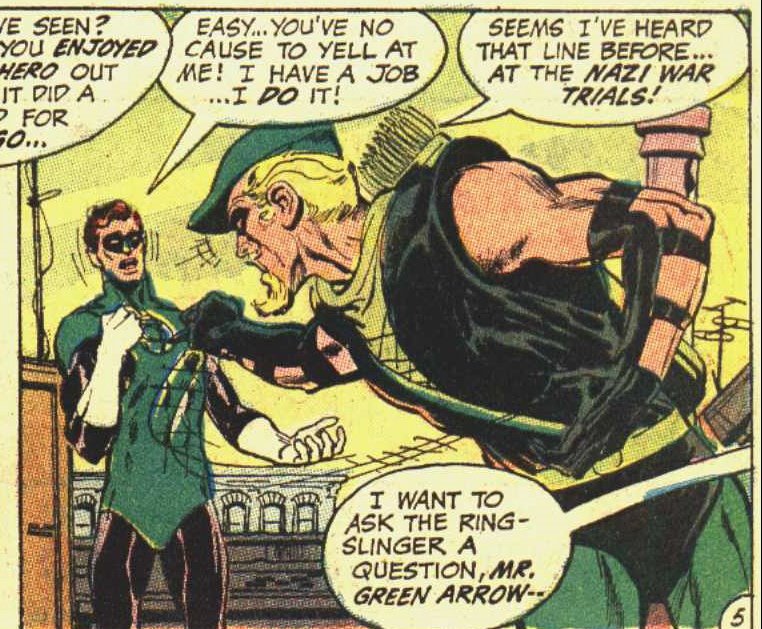
Oliver Queen, the Green Arrow.


Take the Green Lantern/Green Arrow social commentary comic-book series by Denny O'Neil and Neal Adams, for example. This arguably defined both characters for the next 35 years, and it covered a lot of social ground in the meantime. One of the most famous stories, "Snowbirds Don't Fly" tackled drug abuse. It's set right after Hal and Ollie have gotten back from a road trip. This is the "Hard-Traveling Heroes" roadtrip, important because Oliver Queen (white male raised in upper class society) has been teaching Hal Jordan about the evils of racism, sexism, and classism. (Why yes, he does come off as an insensitive jerk even when he's right, how did you know?)


A reader who knows the characters understands that Hal can afford to take this trip. He lives alone, is a traveling salesman (who used to be a pilot, who used to be an insurance investigator...etc... Hal's jobs vary with his girlfriends, but that's another post entirely), has no one depending one him -- he can just pack up and leave. Ollie, on the other hand, has a young sidekick -- Roy Harper, also known as Speedy (and no, I have no idea why they named the archer kid Speedy and the superfast kid Kid Flash) -- that he up and leaves for this trip. The boy appears to be in his teens, and I see no evidence that he had any supervision whatsoever while Ollie was gone.

After the two adults get back, they run into Roy while investigating drugs and assume he's on the same track as them. He even rescues them after they've been knocked out and given drugs in an attempt to frame them.

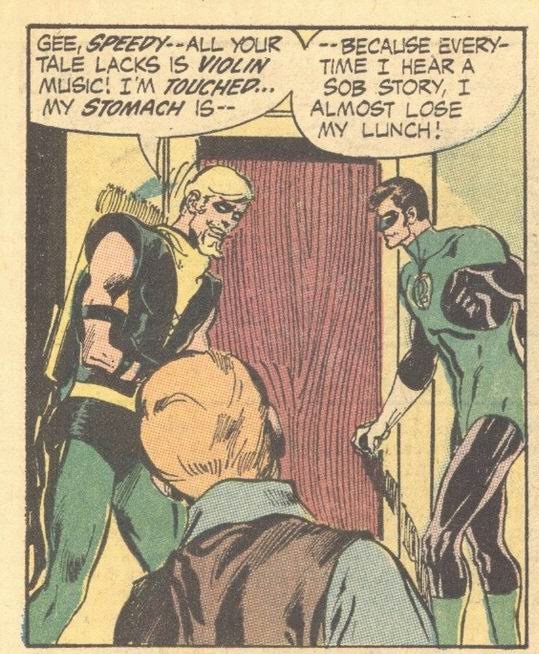
The experience of being high leaves Hal asking why anyone would voluntarily undergo it. Roy gives him an eloquent, tear-jerking, and fucking transparent answer.


Now, most of us who've read DC comics know what he means already, so I may be wrong about how obvious it is. But I'd be willing to lay down my own hard-earned money that the majority of people who see that panel and have no knowledge whatsoever about the DC Universe other than the fact that the blonde bearded idiot and the redheaded kid have a hero-sidekick relationship will be able to know exactly what he's talking about.

But does Ollie?


In fact, he comes home and walks in on Roy in the act of shooting up and is absolutely shocked.

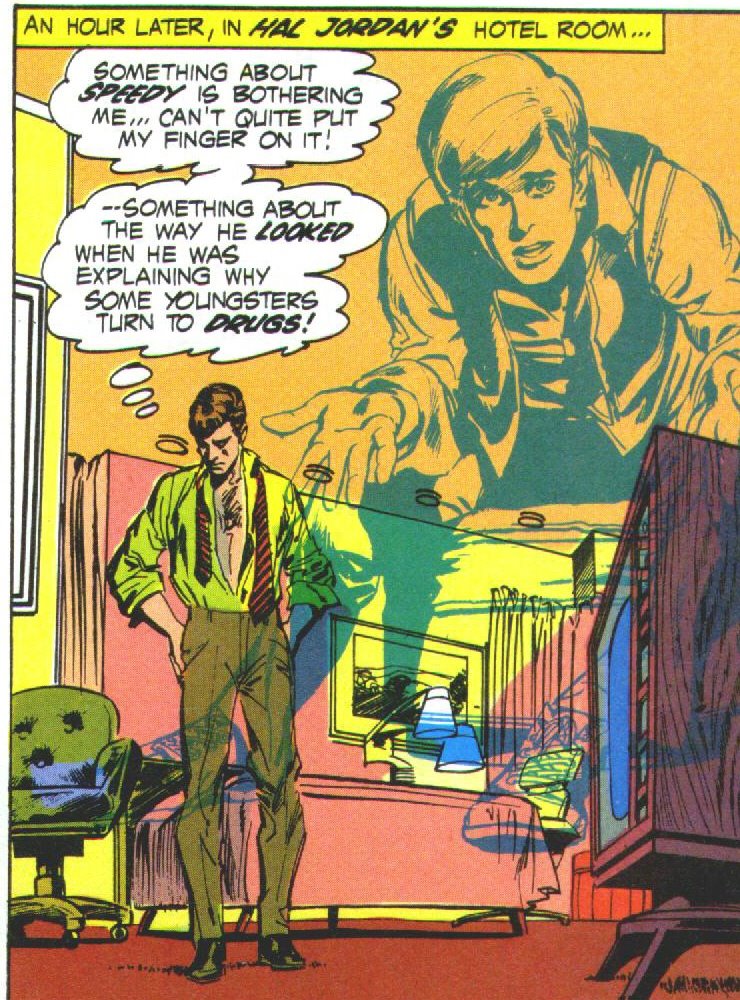
Does Hal? Well, it takes him a while, but he actually gets it.


The proof is in the panels, ladies and gentlemen. Green Lantern is seriously the smarter member of the team.

Wednesday, March 22, 2006

Carnival of Feminists 11/Call for Submissions for 12

Carnival of Feminists issue 11 is up at Angry for a Reason today. Check it out. Then come back and see the commentary on the below picture:


I'll be hosting the Twelfth Carnival of Feminists at this very blog on April 5th (Before I read Infinite Crisis #6 even. It'll be a slight change of pace for my regulars since this isn't normally a political blog unless it crosses into comic books, but it doesn't hurt to visit the real world every once in a while

Requirements: Any posts written to address a woman's place in the world from a feminist point of view are welcome. The optional and arbitary catergories for this issue will be Influences, Inpirations, Culture Reversal and Other. Deadline is April 3rd and I'll be accepting posts made after the last deadline of March 20th.

Please email submissions to ragnellthefoul AT gmail DOT com or attach the Technorati Tag to your post.

EDIT: Also, there's a Blog Carnival Submissions Form for your convenience.

Did he seriously quit over this?

I've been skimming the Isaac Hayes rumors that are flying around not only the blogosphere but the "Respectable" newsmedia. I found the episode YouTubed and linked on someone's livejournal.

I hadn't seen it, but was naturally curious. Was is possible that it was treated with less respect than the major organized religions? I mean, the Mormons got smoked. Maybe there's a reason to be offended. Maybe people are massively misunderstanding Scientologists. My own religion embraces some fairly kooky stuff. It has questionable origins. Who am I to judge?

So, I did try to approach this objectively. Two items did me in.

I'd forgotten what the E-meter was. I've read about the little black box before and was under the impression that it was an unreliable medical tool (In Cults of Unreason I remember reading that shortly after Hubbard began using it, the regular medical community stopped using it) for measuring body temperature and pulse. Good thing I googled it. It's really just an Ohmmeter for your flesh. Now, I must confess I do believe in a lot of New Age and mystical stuff, but I also work on electronics and I can't imagine using test equipment to try and pin down the metaphysical without learning what it's doing and what causes it to do that in the natural world. I think it comes from having to actually read up on all that stupid test equipment in case I actually do need to know how an Ohmmeter is measuring resistance to account for a bad reading. This knowledge about the E-meter threatened to melt a part of brain when I saw it.

I survived that mention, only to have my brain turned to mint jelly around the time they said "..looked like DC-8s.." You see, I've been in Aviation longer than Electronics. I couldn't handle that, and the accompanying animation didn't help.

I had a nice Green Lantern essay in mind, but am unable to complete it because of this experience. While my mind recovers from the shock, see for yourself:

The Episode


The South Park Scientology Episode.

Tuesday, March 21, 2006

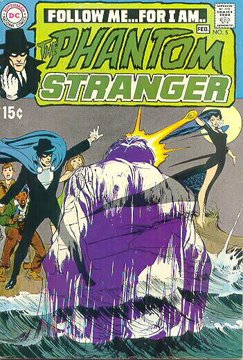
Congratulations, Phantom Stranger!


Well, I found out from Chris of the Two Guys about the DC Press Announcements made at the last convention. One of my favorites, the Phantom Stranger (he is on my SureSell list, though I unforgiveably forgot him until I saw this news) is in line for a "Showcase issue." Now, if this means a Showcase Presents Volume (which I'm all too ready to believe for my own gigginess) I'm amazingly excited. I'm already rubbing my hands together greedily. I can just feel that weighty paperback in my hands, filled to the brim with black and white mystical goodness.

(If it's just a single issue, I still want it. Right now.)

In other news..

-- All Star Wonder Woman is vaguely hinted at, but nothing is overtly confirmed.

-- Jack Knight (Starman, retired) is promised to appear in 52.

-- As is Ambush Bug.

-- And Kyle Rayner still can't cut a break.

Asked if Kyle Rayner would get a new girlfriend, Didio joked, “First we hope he gets a new mask.”
-The next few moments were spent on jokes about the high turnover of Kyle girlfriends, with the highlight being comparisons between Kyle’s girlfriends and drummers for Spinal Tap.


(I hope that means he will actually get a new mask.)

Monday, March 20, 2006

Why I Love Zamaron

The Zamarons are the best alien race in the DCU because of their skilled marriage counselors:

Saturday, March 18, 2006

So I didn't post anything on St. Patrick's Day...

I didn't feel up to it. I'd had a long night at work. It left me wondering why I only ever get to go out to the plane when there's a problem that's not actually there, that we need to sit and try and duplicate for the entire shift.

Oh, and why I always get broken ground support equipment. That wastes a few hours.

I'm green everyday anyway.

But I've also got a smidgeon of Irish Ancestry, so here's a belated gift courtesy of Green Lantern Corps: Recharge #5:

Friday, March 17, 2006

Professional Help May Be in Order...

Chris challenged me earlier tonight when he told me about my last post.

"If you keep this up," he remarked, "you'll have that entire John Stewart story up on your blog with a seven hundred word interpretation of each panel."

"I could easily do that," I answered, "but I'm not really so bad. For example, I can post the third panel tonight with just the sentence 'Never, ever say this to a cop.'"

And I fully intended to do exactly that.

Until I pulled the panel up and saw it separated from the rest of the story.


Then I noticed the threatening posture of the cop, and the size-proximity trick Adams does here, and the shadow falling on John's face. All tricks to make John seem more vulnerable in this situation, and emphasize his courage. There's also some trick with the emotions going on here. The background is suddenly stark white with blue word balloons. Having the word balloons darker than the picture here adds extra emphasize to the word. Tension is building, emotions are running high.

With all those beautiful techniques, who could simply go for the cop joke? I used to just go by the general feeling of an artist. I liked a certain soft cheesecake style, and took little interest outside of it. I grew to appreciate the non-traditional types, because a talent for fluid motion would catch my eyes, or an expressiveness in the characters. Now I'm becoming obsessed for the first time with artistic symbolism. I love it. So much can be conveyed with a few small shortcuts. It's amazing, and, like the writers, I'm not sure the artists realize they are doing this.

I think I may be infatuated with this penciller. I can't stop thinking his panels. His gorgeous, shadowy, symbolic panels. Fortunately for me, I have no address for my embarrassing love letters, so I'll be spared the same humiliation I felt when I realized how much time I'd wasted writing to that kid on Seaquest in elementary school.

Unfortunately for you, dear readers, it means I'll be using this blog as an outlet for my insane ramblings about this story until I find something else to distract me.

If I don't see this distraction today, I'd like to apologize in advance. This could get a lot worse before it gets better.

Thursday, March 16, 2006

Our First Look at John Stewart

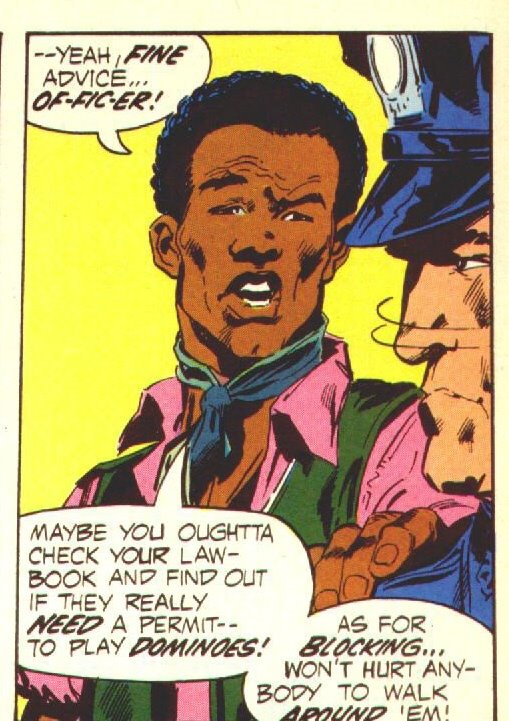
I wasn't going to keep doing this, but the yellow background is nagging at me. Anywhere else, I'd accept that it's a random color. But this is a panel found in Green Lantern. For 30 years, this was the sole weakness of Green Lantern. Their powers were unable to affect anything yellow (Please note the date on that linked post). Yellow is not cavalierly thrown around in this franchise. It's usually there as a means of hurting the main character. It's been there as a mistake, which made Superfriends interesting ("Everytime Green Lantern's ring affects yellow, take a shot").

Sometimes, though, its symbolic. It's the color of the ground on an alien planet, the background of choice for a villain, or the color of an ex-girlfriend's scarf. It can be representative of limitations, weaknesses, vulnerabilities, restrictions, or fears.


This is the first time we get to see John. He is about to be inducted into the Green Lantern Corps, and he is surrounded by yellow. I'm not sure what to make of it. I find it hard to believe that, for a new Lantern's first appearance, they would just arbitrarily pick a "Yellow Background."

There's other subtleties here.

This is the second panel of the page. Right away, any comic book reader knows to chuck the standard superhero image out the door in this setup. The standard would have shown up in the first panel, because why create even minor suspense for what's expected anyway? For a huge surprise, someone we've seen before and have reason not to expect, it's traditional to make the reader turn the page. Here, it's just a panel. O'Neil held off just long enough so that we'd pause and think about what we read and saw before we actually see the new guy. This is a new personed, but this will not be someone like Hal. Most likely, judging by the language of the first panel, this will be someone at odds with Hal.

I think the intended effect of that pause is lost on today's readers. We don't really have a good representation of the American population in regular DC comics yet, but it's a lot better than back then. At this point in time, 1972, it was probably unheard of to bring in a different race as a replacement. So, even with the previous panel, a reader was probably expecting a white man, even with second panel introduction. Probably an activist who'd be at odds with Green Lantern like Green Arrow was, but still with a certain look.

There's not much extra in the panel, they didn't want us to get distracted from John himself. We do learn a lot about him in the first glimpse. Nevertheless, we can learn quit a bit about the man here.

We learn he's a sarcastic smartass who doesn't automatically grant his respect to a scary uniform by his words alone. His sneer and the tilt of his head add a condescending dismissal to this.

We learn he's dumb enough to approach an armed policeman from behind, and touch his shoulder. You don't do that, even joking, without immediately hitting the pavement. (This was just a particularly crummy cop all-around)

He's man enough to wear pink.

He's got a sense of fairness, justice and the courage to step in when he sees an authority figure abusing their authority (again, refer back to the first panel, the sidewalk is not being blocked). Even when he is in all likelihood about to get in severe trouble for it. I can see how Katma Tui, a native of Korugar from when it was under Sinestro's Totalitarian Regime, would be so much more attacted to John than Hal. Hal's a "work with the system" type, his courage is physical. John's social courage is so much more impressive to a woman of Kat's background.

Yet, the yellow background still eludes me. Does it mean that he's leaving restrictions and limitations behind him now? Or does it represent a certain fear that accompanies his actions? He's doing a very brave, but very stupid thing here when he comes up behind a cop who's abusing his authority. Does the yellow in the background subtly tell us that John recognizes his actions, knows the consequences, and is leaving his fears behind him?

It could simply be foreshadowing the rocky start to his relationship with Hal. They start off fine as trainer and trainee, but there's a barrier created by unspoken feelings. The obvious cause for the barrier (particularly in this run of Green Lantern) is prejudice. I picked up this story expecting an After School Special about racism. But that level of characterization is actually quite subtle. It exists, and surfaces, but there is a much more overt character conflict that causes the barrier. Hal and John have separate values. Hal's worship of Authority is well-established by this point in O'Neil's run. John's attitude towards authority is immediately established in this panel. Hal is placed in authority over John as his trainer, and Hal is witnessing this scene as his first impression of John. Ther judgement is there on both appearance and character. The racial prejudice is a much more obvious problem. It's something both men want to avoid, they don't want to confront this attitude. As a result, the major disagreement, the dissenting values, goes unexplored and unresolved. This creates an undercurrent of tension between the two that lasts much of the John's initial training, until the plot of the story interferes and forces both conflicts to the surface.

Because most of the barrier on Hal's side is caused by this first impression, it's very sensible to introduce John surrounded by a color that presents a barrier to Hal's powers.

Wednesday, March 15, 2006

Katma Tui's First Look

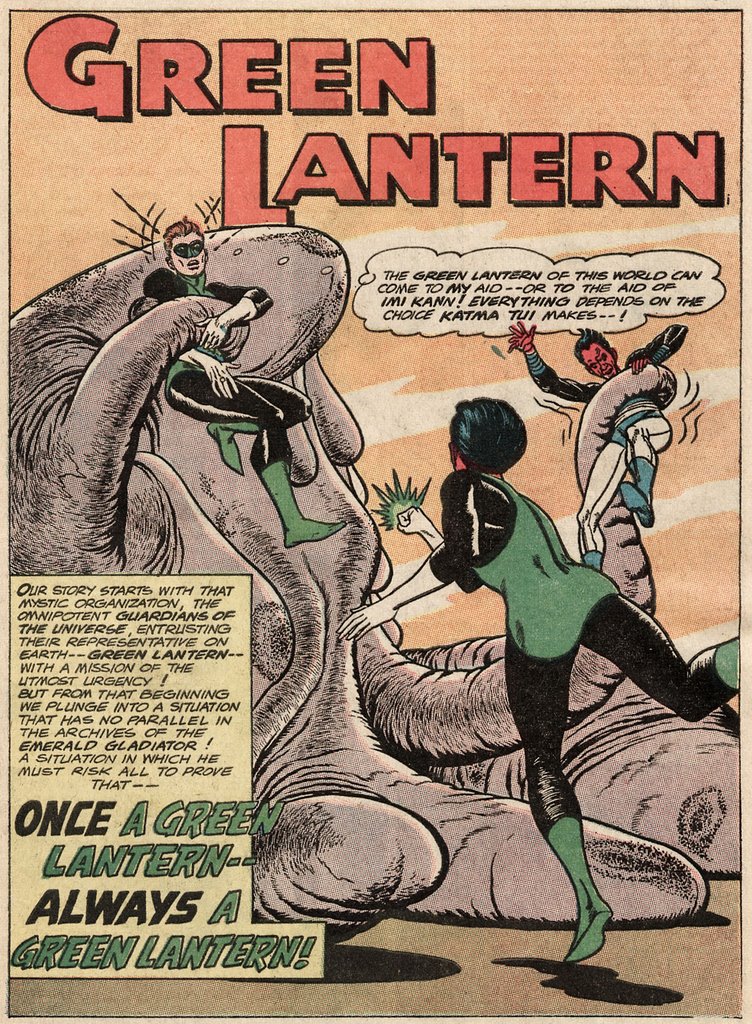
I found the debut story Katma Tui, the first female Green Lantern. Published way back in 1964, in the back of Green Lantern #30. Here's the title page. It has a significance that my regular readers will understand instantly.


(Here's a clue for the rest of you)

Monday, March 13, 2006

Warrior Wrongness

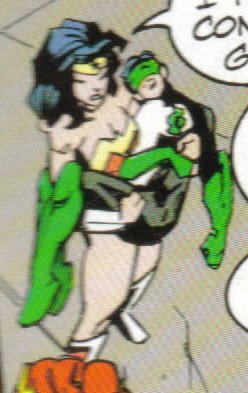
Guy Gardner: Warrior was a weird comic. Some of the plotlines included extras like the main character finding out that he's an alien-human hybrid and the last of an almost extinct species, the main character speaking the dialect of a Norse Demi-goddess that he used to date, random Lobo appearances, physical trips to Guy's subconscious, a Restaurant premier attended by every superhero in the DCU, hand-to-hand combat with Parallax, and involuntary gender-bending to say the least.

One image, however, stands out from the crowd for it's sheer WTF-?ness. Because under no circumstances should Wonder Woman ever, ever, even in a dream sequence, even doing a sarcastic joke making fun of the women in Patriarch's World or how the men think of women, ever look like this:


Should a fantasy sequence ever call for her to strike such a pose, she should stop immediately beforehand and apologize. "I'm sorry, I just can't do it. It's just not me." It will be okay, she can take the paycut. Have Donna Troy stand in.

This picture is at odds with every know character trait of the Amazon Princess. It's jarring. That pose and that character simply do not belong together in a sane universe. Actually, it's even beyond Alternate Reality strangeness. That pose and that character simply do not belong together.

My mind will not accept this picture. My eyes slide off the page and the image leaks out of the back of my head. Each time I look at it, I am traumatized anew because I was unable to log the image in my memory.

It is just not right.

Sunday, March 12, 2006

Stewart's First Words

I got my hands on the first John Stewart story -- Green Lantern #87 (Volume 2). To be honest I was expecting to hate it, but I wanted too badly to see John's creation. I think my low expectations may have been because of Winick's heavy-handed run on Green Lantern, but that's enough material for a whole other post.

Instead, I'm going to show first panel of the first page that featured John, and share two thoughts about it.


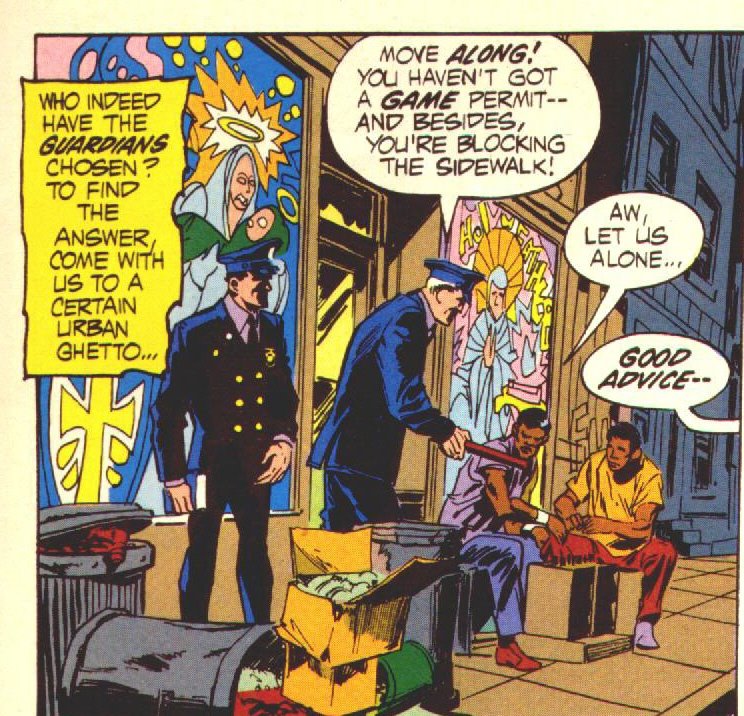
Notice the word Guardians is in strong text. Hal and Guy were both chosen by a desperate dying Green Lantern. So was Sinestro. John is the first character personally selected by the Guardians. The intention may have been to show that this was standard practice, but it's the first time we've seen it. I think this was a subtle characterization fo Hal. O'Neil essentially said that Hal would never have picked Hohn, even if the ring outright told him that john was the best choice. The higher-ups had to specifically step in and tell him "You will train this man."

I like how Adams subtly characterizes the "Good Cop" in this panel. He positions him directly beneath the halo. He's standing up straight, standing back from the wrong that's occuring and holding a book that resembles a Bible. Meanwhile, the "Bad Cop"stands on a darkened doorstop and shakes his weapon threateningly. These characters only appear for half a page, but he sets up the basic personalities very clearly.

Finally, I may be stretching a bit here, but it's funny that John's first words in print are "Good Advice." This is pretty much the role John plays as a Lantern now. He gives good advice. He was basically a mentor and advisor during Kyle's tenure. Now that he's back to active duty, John still only appears in the advisor role. He relays information from other heroes and spouts exposition to Hal, who then goes and deals with the action.

Hell, even in Mosaic John's personal story, John was there in an advisory capacity. He was there to try and get everyone to learn to communicate and live together, and keep problems under wraps -- but all John could really do was advise. The communication and learning of the Mosaic was in the hands of the residents. This may be because, from the very start, John tends to be portrayed as more intelligent, stable and thoughtful than the characters around him. He's generally not the person in need of advice, so writers use him to give it to the other characters. This probably contributes to his being shoved into the background.

Saturday, March 11, 2006

I Can't Look Away

Posting came to a Screeching Halt this week due to my fascination with the workings of flawed logic and my procrastination when it requires me to reread my own post to find out where the miscommunication occurred.

As a result of this morbid combination, I've left my "Adolescent Power Fantasy" thread up for three days, and not added anything to the discussion brewing there. Each day I find a longer list of things to address should I choose to post. I'm putting it off until I've slept again, because as I stated above, it requires me to reread my own wretched writing. Rest assured, reasonable readers, I will set the record straight.

Then regular posting will resume.

In the meantime, please enjoy these other choice selections:
-- Referring back to the below conversation on femininity, Dan asks about masculinity (and compliments me so nicely I'm not sure how to respond).
-- Gordon's Blog Against Sexism Day post which I thought I'd mention here because I can't seem to get comments to work on his blog, and I couldn't fit it under the topics of WFA.
-- Jen risks her independant mind and soul to review FX's Black. White. Episode 1 for us. *Shudder* Reality TV.
-- I agree with Mickle about Disney Princesses. And I thought her grammar lesson added another dimension to Kalinara's complaint.
-- I've been spending a lot of time wandering around Scott's Comics and Medicine archvies. Too much perhaps, because when I read through this old argument on Insensitive Gynecologists and came to a comment that described one lady's incredibly lucky find (after the pregnancy rant, third Doctor described) all I could think of was how much he sounded like Dr. Mid-nite. She didn't outright mention that he was blind, and had a slight Norwegian accent and an owl in the examination room. But still, not too far off.
-- And, if that's not enough, Tuesday saw the Tenth Carnival of Feminists posted for your reading pleasure.

Wednesday, March 08, 2006

Where's My Adolescent Power Fantasy?

(My own Blog Against Sexism Day contribution)


I got into an argument in a chatroom once. I'll pause here long enough for you to get over your disbelief. Anyway, someone expressed annoyance that the majority of new female characters were of the "Amazon" variety. Which confused me, since we hadn't had new Amazons come out of Wonder Woman for a few years yet. He said that he felt that there were personality differences in men and women, and that most of the female characters he saw were like "men with breasts." This statement annoyed me immeasurably, but it was long before I'd really started to think about feminity. I was still taking gender roles at face value. I listed off a few nuturer and female stereotype characters that were popular (Ice, Donna Troy -- which got into an argument in and off itself. "You think Donna Troy is a soft nuturer?" "Yes. She's a soapy supportive type woman who loses her temper easily. Stereotype nuturer") and spouted some New Age explanation of feminity (which now that I've had time to explore the question a bit, seems horrifically erroneous) that he found 'interesting' and we decided to end the disagreement with a truce.

The Point

But this argument stayed with me, long after I'd forgotten the name of the man I disagreed with. I've only recently realized why. He was trying to tell me that the characters that I identified with, the characters who behaved in the way that I wanted to be able to, were unfeminine. He was essentially telling me that not only did I not want to be a woman, I wasn't even a valid woman because I wasn't a soft, receptive, nuturer. The more I think about this, the angrier I get, and the better it is that I don't rememebr his name. I'd love to set him straight, though.

He and like-minded individuals who call strong women characters "men with breasts" or "Amazons" (same tone as "Unicorns") are missing something very important. They've probably realized that superheroes are an "Adolescent Power Fantasy" because that much is obvious. But they think of twelve year old boys when they think of it. They haven't looked beyond their own gender to realize that woman also have "Adolescent Power Fantasies." It's unheard of, because females are supposed to fantasize about love and romance and world peace and crap like that. Women don't want to be punch out the people who offend them. That's ridiculous, only men have those impulses. Women want more substance from their comics. They read Sandman dontcha know?

I suppose now I should clarify that this was a chatroom on a superhero fansite, specifically about Green Lantern. And it would be logical to conclude that a woman reading Green Lantern is probably reading it because it has the same appeal for her that it would if she were a man. I freely admit to reading a lot into my comic books. Particularly superheroics. It's not because I specifically got into superhero comics looking for meaning and symbolism. It's because I was already reading the books and I started to notice the patterns.

I started reading when I was teenaged girl. I was just being exposed to the real world and its attitudes about women. I was not happy about it. My mother embarked on quest to ensure that I would never trust a boy enough to get pregnant during High School or college. To give you an idea of how intense this could be, I'll give you a tamer example. As a pre-teen, I once mention offhandedly that I liked watching Daktari reruns and got a story about a young woman who was cannibalized on a trip to Africa in return.
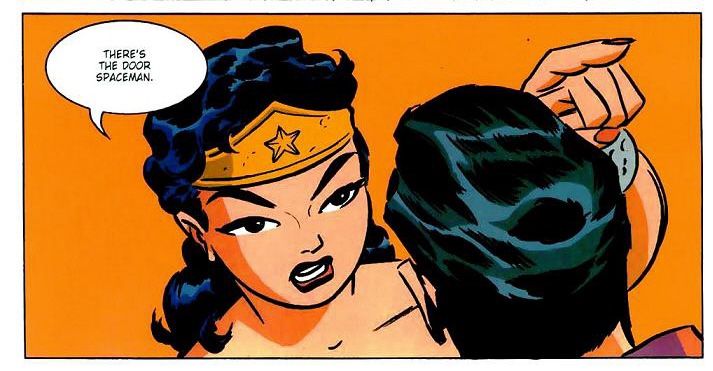
School was no better. Current Events, World Cultures, Criminology, Sociology, Spanish, Physical Education. We were learning about sexual harassment, and sexism, and seeing it actively demonstrated. Discussing it was good, but frustrating. There was very little that we, as high school students could do about the anecdotes we were hearing. For me, there was something very freeing about reading JLA. My sister complained that Wonder Woman didn't have enough panel time, was drawn as a doe-eyed innocent, and wore a ridiculous costume. But there was no denying the power she showed when she did show up. Zauriel stopped to start at her butt, Hitman made the x-ray vision joke, but as I was seeing, every male on that team still respected her when she did show up. No one dismissed anything she said.


I kept reading, though I spouted off about the same things my sister did. Despite starting out as a mouse, I somehow gained a reputation as the most fierce feminist in my school. Got into more than a few fights. When the "What mutant power would you have?" game came up in the geeky circles I ran in, I was usually assigned super-strength or some other physical power.

Time went on, I still read. I still heard horror stories, to the point that the only school I applied for was an all-girls liberal studies school. At the last minute, economic necessity, my father's example (he's a policeman), and the idealism gleaned from comic books won over. I signed up for the military. Everyone was in complete shock at this news. I plunged myself into the most masculine, traditionalist atmosphere available.

After Basic, I was a mouse. I couldn't act the way I did in high school and still get away with it. And adult can't hit another adult without legal reprisals, especially in the military. I wasn't a skilled debater, I often found myself backed into a corner during an argument so just stayed out of the controversal stuff. Having been already inclined to modesty (somewhere growing up I picked up the idea that it was a virtue), and now inclined to following orders, I withdrew for a few years. I generally followed the lead of stronger men and women. I had a friend at my first duty station, Liz, who had a great effect on me. She was a country bumpkin type. Too level-headed to get backed into an argumentative corner. She had no need to be violent, and was sexually active without worrying. I spent a lot of time around her at first, and after a while broke away. I latched onto a few more people, and clung to security blanket of military equal opportunity. I didn't experience or notice any problems on the job due to my gender, but I wasn't willing to explore the actual opinions of the men around me. I didn't want to have to argue around it. I dind't get my confidence or backbone back until I learned to discuss these things openly without getting upset, and without getting talked into a corner. This took years and after I got past that, I even found mice following me like I followed Liz. Through all that, of course, I still read.


And through all of that, even now, I still encounter those little moments. Little offhand comments, looks, and overall attitudes. Mostly off the job. Things not really worth getting into, and certainly not worth hitting someone or getting into trouble over, but annoying things nonetheless. I like the quiet moments, when I can take someone aside and discuss it. Sometimes I misinterpreted it, sometimes they didn't realize just how stupid they were being. Sometimes, I'm up against a brick wall. I'd love to punch through it, but this is the real world and there are ways of dealing with problems (long way, involving months of paperwork) that are acceptable.

Some days, you just feel like hitting something. Super-strength and invulnerability would be nice. So would a secret identity. I'd love to be able to take the jerks of the world to task immediately instead of waiting out the system. I want to act like a superhero. I want to talk, dress, and look like a superhero. I want to hit the guy who deserves it. I want to wear what I like and still be taken seriously. I want to say cheesy things like "I can't take time out for a social life, Steve Trevor, until the world is safe from crime!"

I want to get my own damned cat out of the tree.

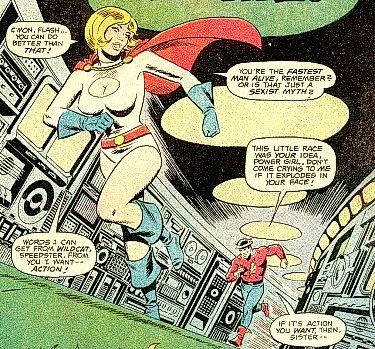
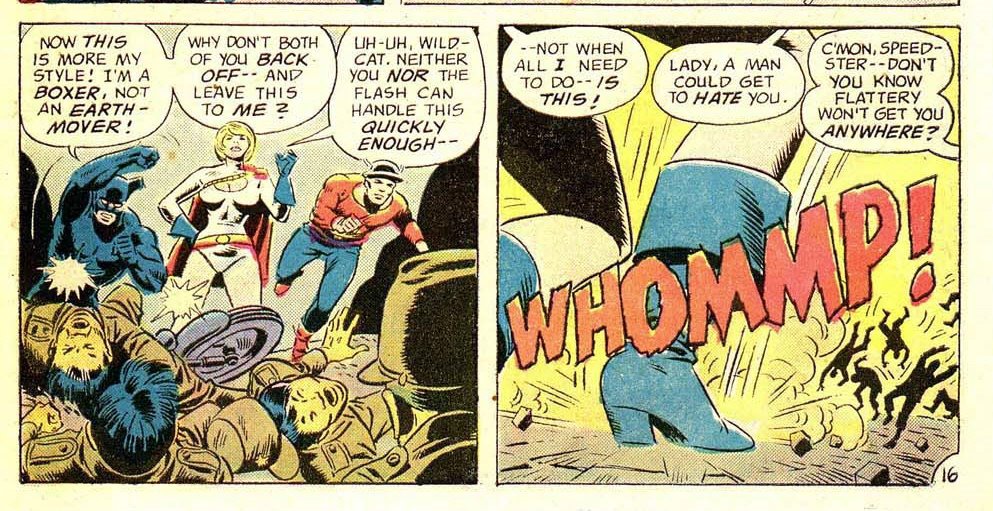
I see the feminine appeal of Power Girl. Here is a woman so formidable that she can walk around with a hole in her shirt and not worry about attracting unwanted attention. She shows up on the scene, and her colleagues say "Great! A heavy hitter!" She can apply my methods of problem solving, but she can also deal with these problems in a way not possible for any law abiding citizen. JSA #39 was pure fun, simply because I'd had the exact same fantasy years before, sitting in Sociology class and watching a Lifetime-style movie about how difficult it was to prosecute a stalker.


My tastes are matured, yes. I like some depth in a story, I chase symbolism, I'm interested in character interaction and wild plots and entertaining dialogue. Just watching a woman beat up a guy is not enough to make me like a book anymore, I generally want something more. But every once in a while, I still want my Adolescent Power Fantasy. Especially when I see sexism brought up by the characters in the story. If a female character has to deal with a jerk, then I want to see her deal with him in the most harsh way possible. The way I can only dream of dealing with him.

Which brings me to what I'd originally intended this essay to be about -- Witchblade #91 disappointed me. I was in the business of giving Ron Marz the benfit of the doubt. On the second read, I'd enjoyed his Green Lantern stuff, but was still iffy about his handling of female characters, so out of curiosity I picked up issues 89 to 92. Sara Pezzini sounds a little like Kyle Rayner in the narration, which is good actually. I liked Kyle's narration. And he follows through on his rules about supporting cast members getting pounded regardless of gender (Poor Gleason). And, for the first time, the main character of Witchblade came across like a three-dimensional person. But the plot let me down.

A federal agent is introduced who comes onto Sara. Now, right away, he's showing the narrative signs of evil (the writer was using sexual harassment as dramatic shorthand for Jerk) so I know he's not actually there as a sleezy disappointing love interest. He's there to get beat up. Yay! And he does get beat up, in issue 91, proving that the writer understood that a sexist bastard introduced in the first act must have his ass handed to him in the third. What Mr. Marz missed, of course, was that if the offended female character is the main character, then she is the only one with the right to beat up the offender. Here, a guest star did it. Sara never got a chance to touch him. Hell, neither did her partner Gleason and he said some things to him that really deserved a punch in the mouth.
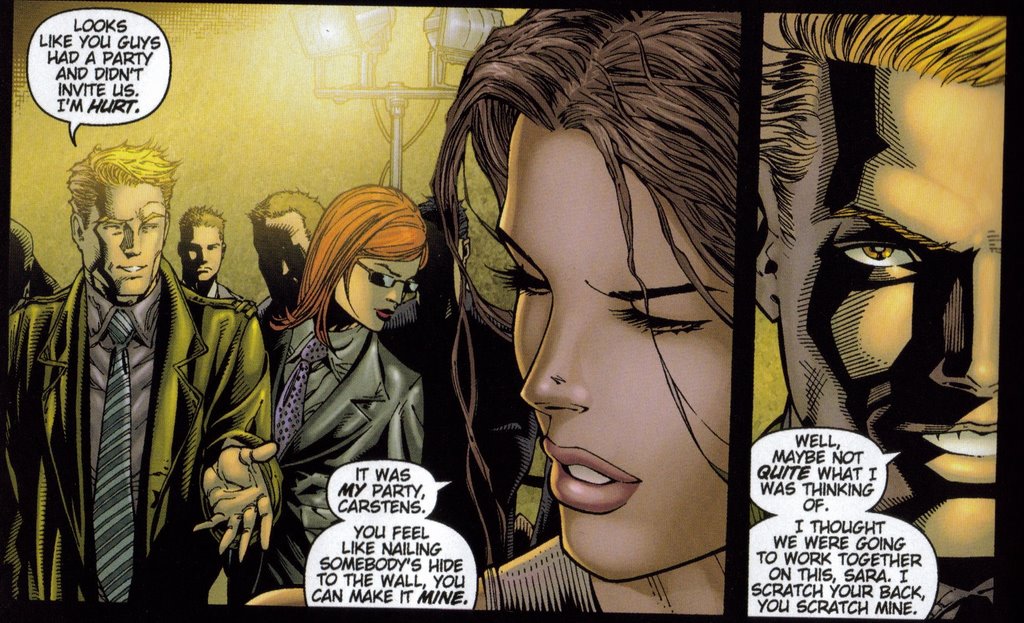
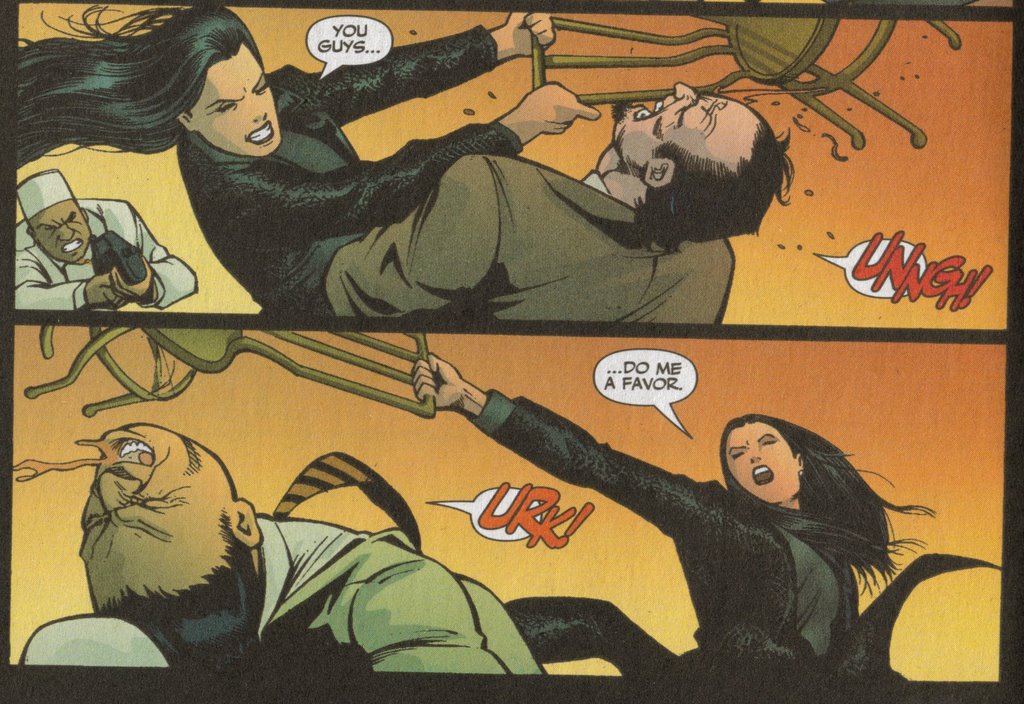


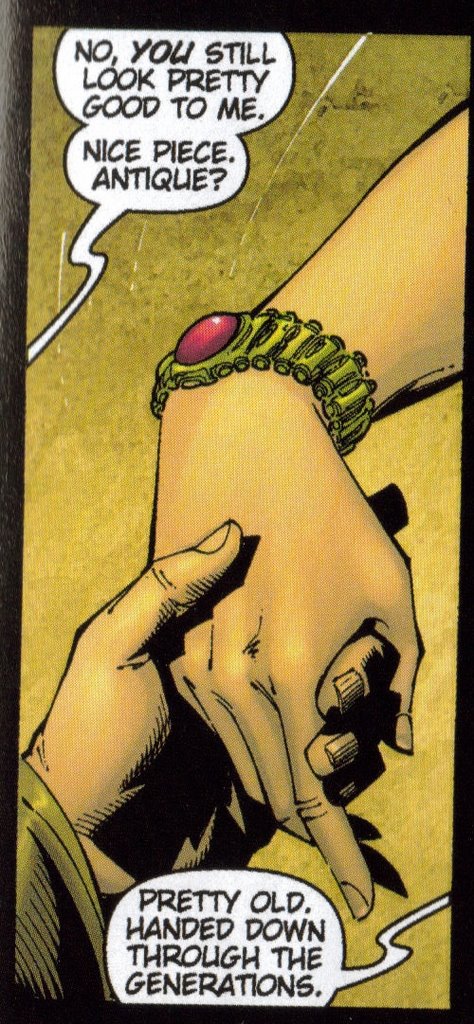
Now, this is just Marz's style of writing. I've seen him do this with Kyle several times, too, and it didn't really bother me because the subject matter was different. In a standard superhero comic, you are going to have stories where the main character doesn't personally solve every problem. I probably would have liked it in this story, were it not for the fact that sexual harassment against Sara was being used to characterize the guy. She had been hit on several times by this guy, and he even grabbed her wrist with his creepy hand. She didn't like him, he was sleezy and pushy. She reacted like a most woman in that position, she glossed over it and tried to get on with her job. He would leave soon anyway. I've seen this happen, I've heard of it happening to friends. This is a problem not far from my mind, or really the mind of most working women. We're not superheroes like Sara, though. We don't have a powerful mystical artifact like Sara does, and so we have to work through our problems in a rational, nonviolent way. But in situations like this, you do feel like hitting someone. It would have been undescribably satisfying to be able to vicariously kick this guy's ass through Sara.

Thankfully, Birds of Prey was next on the pile that week.