Saturday, March 18, 2006

So I didn't post anything on St. Patrick's Day...

I didn't feel up to it. I'd had a long night at work. It left me wondering why I only ever get to go out to the plane when there's a problem that's not actually there, that we need to sit and try and duplicate for the entire shift.

Oh, and why I always get broken ground support equipment. That wastes a few hours.

I'm green everyday anyway.

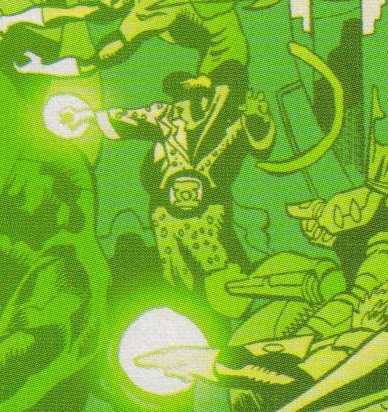
But I've also got a smidgeon of Irish Ancestry, so here's a belated gift courtesy of Green Lantern Corps: Recharge #5:
Friday, March 17, 2006

Professional Help May Be in Order...

Chris challenged me earlier tonight when he told me about my last post.

"If you keep this up," he remarked, "you'll have that entire John Stewart story up on your blog with a seven hundred word interpretation of each panel."

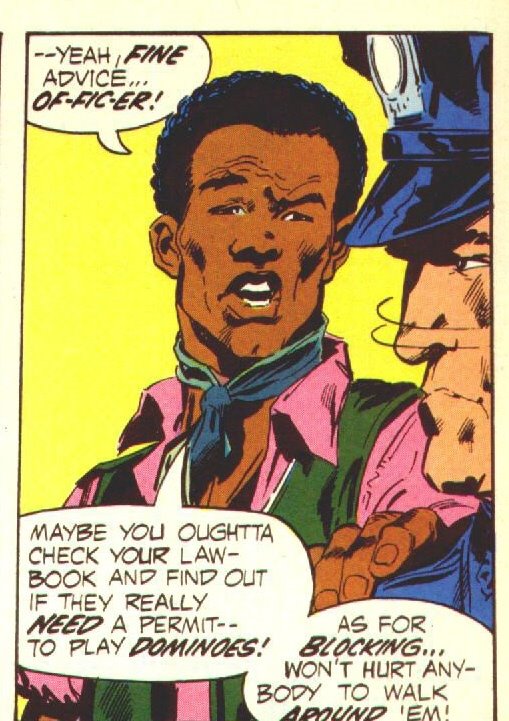
"I could easily do that," I answered, "but I'm not really so bad. For example, I can post the third panel tonight with just the sentence 'Never, ever say this to a cop.'"

And I fully intended to do exactly that.

Until I pulled the panel up and saw it separated from the rest of the story.


Then I noticed the threatening posture of the cop, and the size-proximity trick Adams does here, and the shadow falling on John's face. All tricks to make John seem more vulnerable in this situation, and emphasize his courage. There's also some trick with the emotions going on here. The background is suddenly stark white with blue word balloons. Having the word balloons darker than the picture here adds extra emphasize to the word. Tension is building, emotions are running high.

With all those beautiful techniques, who could simply go for the cop joke? I used to just go by the general feeling of an artist. I liked a certain soft cheesecake style, and took little interest outside of it. I grew to appreciate the non-traditional types, because a talent for fluid motion would catch my eyes, or an expressiveness in the characters. Now I'm becoming obsessed for the first time with artistic symbolism. I love it. So much can be conveyed with a few small shortcuts. It's amazing, and, like the writers, I'm not sure the artists realize they are doing this.

I think I may be infatuated with this penciller. I can't stop thinking his panels. His gorgeous, shadowy, symbolic panels. Fortunately for me, I have no address for my embarrassing love letters, so I'll be spared the same humiliation I felt when I realized how much time I'd wasted writing to that kid on Seaquest in elementary school.

Unfortunately for you, dear readers, it means I'll be using this blog as an outlet for my insane ramblings about this story until I find something else to distract me.

If I don't see this distraction today, I'd like to apologize in advance. This could get a lot worse before it gets better.

Thursday, March 16, 2006

Our First Look at John Stewart

I wasn't going to keep doing this, but the yellow background is nagging at me. Anywhere else, I'd accept that it's a random color. But this is a panel found in Green Lantern. For 30 years, this was the sole weakness of Green Lantern. Their powers were unable to affect anything yellow (Please note the date on that linked post). Yellow is not cavalierly thrown around in this franchise. It's usually there as a means of hurting the main character. It's been there as a mistake, which made Superfriends interesting ("Everytime Green Lantern's ring affects yellow, take a shot").

Sometimes, though, its symbolic. It's the color of the ground on an alien planet, the background of choice for a villain, or the color of an ex-girlfriend's scarf. It can be representative of limitations, weaknesses, vulnerabilities, restrictions, or fears.


This is the first time we get to see John. He is about to be inducted into the Green Lantern Corps, and he is surrounded by yellow. I'm not sure what to make of it. I find it hard to believe that, for a new Lantern's first appearance, they would just arbitrarily pick a "Yellow Background."

There's other subtleties here.

This is the second panel of the page. Right away, any comic book reader knows to chuck the standard superhero image out the door in this setup. The standard would have shown up in the first panel, because why create even minor suspense for what's expected anyway? For a huge surprise, someone we've seen before and have reason not to expect, it's traditional to make the reader turn the page. Here, it's just a panel. O'Neil held off just long enough so that we'd pause and think about what we read and saw before we actually see the new guy. This is a new personed, but this will not be someone like Hal. Most likely, judging by the language of the first panel, this will be someone at odds with Hal.

I think the intended effect of that pause is lost on today's readers. We don't really have a good representation of the American population in regular DC comics yet, but it's a lot better than back then. At this point in time, 1972, it was probably unheard of to bring in a different race as a replacement. So, even with the previous panel, a reader was probably expecting a white man, even with second panel introduction. Probably an activist who'd be at odds with Green Lantern like Green Arrow was, but still with a certain look.

There's not much extra in the panel, they didn't want us to get distracted from John himself. We do learn a lot about him in the first glimpse. Nevertheless, we can learn quit a bit about the man here.

We learn he's a sarcastic smartass who doesn't automatically grant his respect to a scary uniform by his words alone. His sneer and the tilt of his head add a condescending dismissal to this.

We learn he's dumb enough to approach an armed policeman from behind, and touch his shoulder. You don't do that, even joking, without immediately hitting the pavement. (This was just a particularly crummy cop all-around)

He's man enough to wear pink.

He's got a sense of fairness, justice and the courage to step in when he sees an authority figure abusing their authority (again, refer back to the first panel, the sidewalk is not being blocked). Even when he is in all likelihood about to get in severe trouble for it. I can see how Katma Tui, a native of Korugar from when it was under Sinestro's Totalitarian Regime, would be so much more attacted to John than Hal. Hal's a "work with the system" type, his courage is physical. John's social courage is so much more impressive to a woman of Kat's background.

Yet, the yellow background still eludes me. Does it mean that he's leaving restrictions and limitations behind him now? Or does it represent a certain fear that accompanies his actions? He's doing a very brave, but very stupid thing here when he comes up behind a cop who's abusing his authority. Does the yellow in the background subtly tell us that John recognizes his actions, knows the consequences, and is leaving his fears behind him?

It could simply be foreshadowing the rocky start to his relationship with Hal. They start off fine as trainer and trainee, but there's a barrier created by unspoken feelings. The obvious cause for the barrier (particularly in this run of Green Lantern) is prejudice. I picked up this story expecting an After School Special about racism. But that level of characterization is actually quite subtle. It exists, and surfaces, but there is a much more overt character conflict that causes the barrier. Hal and John have separate values. Hal's worship of Authority is well-established by this point in O'Neil's run. John's attitude towards authority is immediately established in this panel. Hal is placed in authority over John as his trainer, and Hal is witnessing this scene as his first impression of John. Ther judgement is there on both appearance and character. The racial prejudice is a much more obvious problem. It's something both men want to avoid, they don't want to confront this attitude. As a result, the major disagreement, the dissenting values, goes unexplored and unresolved. This creates an undercurrent of tension between the two that lasts much of the John's initial training, until the plot of the story interferes and forces both conflicts to the surface.

Because most of the barrier on Hal's side is caused by this first impression, it's very sensible to introduce John surrounded by a color that presents a barrier to Hal's powers.

Wednesday, March 15, 2006

Katma Tui's First Look

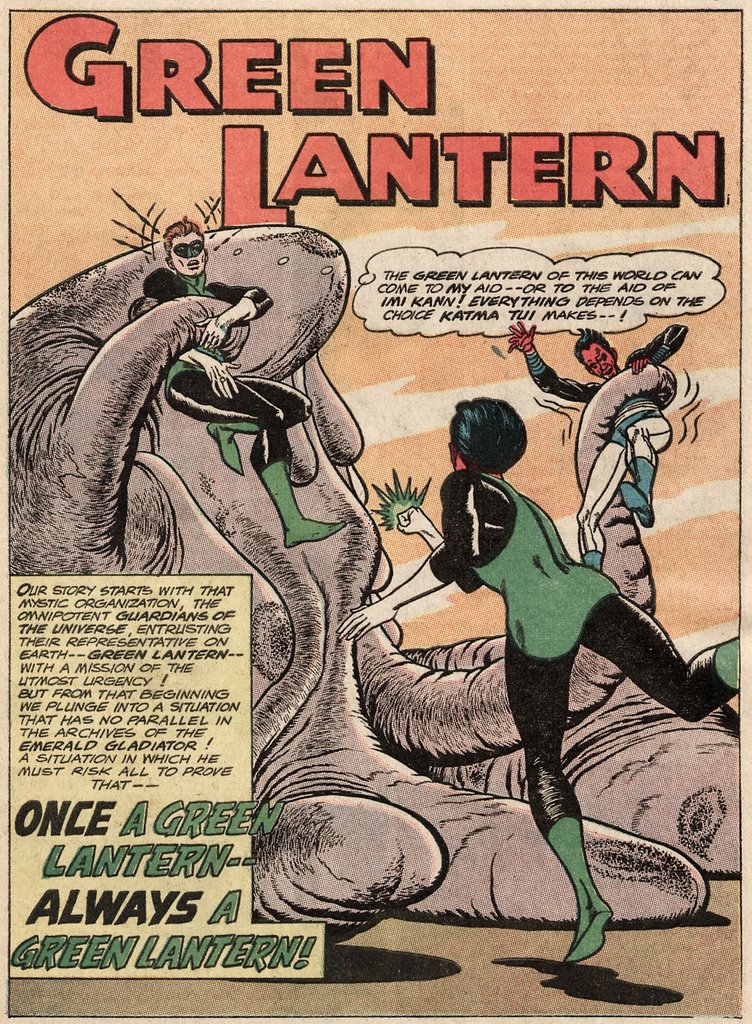
I found the debut story Katma Tui, the first female Green Lantern. Published way back in 1964, in the back of Green Lantern #30. Here's the title page. It has a significance that my regular readers will understand instantly.


(Here's a clue for the rest of you)

Monday, March 13, 2006

Warrior Wrongness

Guy Gardner: Warrior was a weird comic. Some of the plotlines included extras like the main character finding out that he's an alien-human hybrid and the last of an almost extinct species, the main character speaking the dialect of a Norse Demi-goddess that he used to date, random Lobo appearances, physical trips to Guy's subconscious, a Restaurant premier attended by every superhero in the DCU, hand-to-hand combat with Parallax, and involuntary gender-bending to say the least.

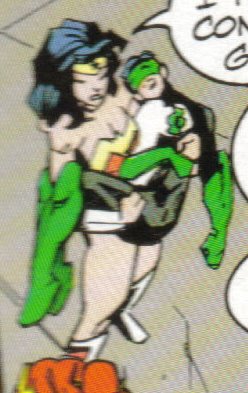
One image, however, stands out from the crowd for it's sheer WTF-?ness. Because under no circumstances should Wonder Woman ever, ever, even in a dream sequence, even doing a sarcastic joke making fun of the women in Patriarch's World or how the men think of women, ever look like this:


Should a fantasy sequence ever call for her to strike such a pose, she should stop immediately beforehand and apologize. "I'm sorry, I just can't do it. It's just not me." It will be okay, she can take the paycut. Have Donna Troy stand in.

This picture is at odds with every know character trait of the Amazon Princess. It's jarring. That pose and that character simply do not belong together in a sane universe. Actually, it's even beyond Alternate Reality strangeness. That pose and that character simply do not belong together.

My mind will not accept this picture. My eyes slide off the page and the image leaks out of the back of my head. Each time I look at it, I am traumatized anew because I was unable to log the image in my memory.

It is just not right.

Sunday, March 12, 2006

Stewart's First Words

I got my hands on the first John Stewart story -- Green Lantern #87 (Volume 2). To be honest I was expecting to hate it, but I wanted too badly to see John's creation. I think my low expectations may have been because of Winick's heavy-handed run on Green Lantern, but that's enough material for a whole other post.

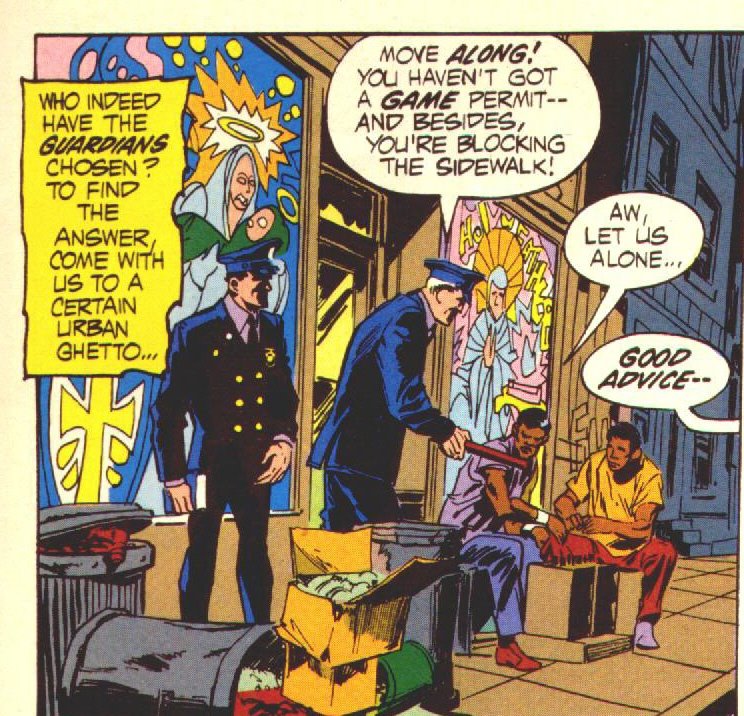
Instead, I'm going to show first panel of the first page that featured John, and share two thoughts about it.


Notice the word Guardians is in strong text. Hal and Guy were both chosen by a desperate dying Green Lantern. So was Sinestro. John is the first character personally selected by the Guardians. The intention may have been to show that this was standard practice, but it's the first time we've seen it. I think this was a subtle characterization fo Hal. O'Neil essentially said that Hal would never have picked Hohn, even if the ring outright told him that john was the best choice. The higher-ups had to specifically step in and tell him "You will train this man."

I like how Adams subtly characterizes the "Good Cop" in this panel. He positions him directly beneath the halo. He's standing up straight, standing back from the wrong that's occuring and holding a book that resembles a Bible. Meanwhile, the "Bad Cop"stands on a darkened doorstop and shakes his weapon threateningly. These characters only appear for half a page, but he sets up the basic personalities very clearly.

Finally, I may be stretching a bit here, but it's funny that John's first words in print are "Good Advice." This is pretty much the role John plays as a Lantern now. He gives good advice. He was basically a mentor and advisor during Kyle's tenure. Now that he's back to active duty, John still only appears in the advisor role. He relays information from other heroes and spouts exposition to Hal, who then goes and deals with the action.

Hell, even in Mosaic John's personal story, John was there in an advisory capacity. He was there to try and get everyone to learn to communicate and live together, and keep problems under wraps -- but all John could really do was advise. The communication and learning of the Mosaic was in the hands of the residents. This may be because, from the very start, John tends to be portrayed as more intelligent, stable and thoughtful than the characters around him. He's generally not the person in need of advice, so writers use him to give it to the other characters. This probably contributes to his being shoved into the background.

Saturday, March 11, 2006

I Can't Look Away

Posting came to a Screeching Halt this week due to my fascination with the workings of flawed logic and my procrastination when it requires me to reread my own post to find out where the miscommunication occurred.

As a result of this morbid combination, I've left my "Adolescent Power Fantasy" thread up for three days, and not added anything to the discussion brewing there. Each day I find a longer list of things to address should I choose to post. I'm putting it off until I've slept again, because as I stated above, it requires me to reread my own wretched writing. Rest assured, reasonable readers, I will set the record straight.

Then regular posting will resume.

In the meantime, please enjoy these other choice selections:
-- Referring back to the below conversation on femininity, Dan asks about masculinity (and compliments me so nicely I'm not sure how to respond).
-- Gordon's Blog Against Sexism Day post which I thought I'd mention here because I can't seem to get comments to work on his blog, and I couldn't fit it under the topics of WFA.
-- Jen risks her independant mind and soul to review FX's Black. White. Episode 1 for us. *Shudder* Reality TV.
-- I agree with Mickle about Disney Princesses. And I thought her grammar lesson added another dimension to Kalinara's complaint.
-- I've been spending a lot of time wandering around Scott's Comics and Medicine archvies. Too much perhaps, because when I read through this old argument on Insensitive Gynecologists and came to a comment that described one lady's incredibly lucky find (after the pregnancy rant, third Doctor described) all I could think of was how much he sounded like Dr. Mid-nite. She didn't outright mention that he was blind, and had a slight Norwegian accent and an owl in the examination room. But still, not too far off.
-- And, if that's not enough, Tuesday saw the Tenth Carnival of Feminists posted for your reading pleasure.

Wednesday, March 08, 2006

Where's My Adolescent Power Fantasy?

(My own Blog Against Sexism Day contribution)


I got into an argument in a chatroom once. I'll pause here long enough for you to get over your disbelief. Anyway, someone expressed annoyance that the majority of new female characters were of the "Amazon" variety. Which confused me, since we hadn't had new Amazons come out of Wonder Woman for a few years yet. He said that he felt that there were personality differences in men and women, and that most of the female characters he saw were like "men with breasts." This statement annoyed me immeasurably, but it was long before I'd really started to think about feminity. I was still taking gender roles at face value. I listed off a few nuturer and female stereotype characters that were popular (Ice, Donna Troy -- which got into an argument in and off itself. "You think Donna Troy is a soft nuturer?" "Yes. She's a soapy supportive type woman who loses her temper easily. Stereotype nuturer") and spouted some New Age explanation of feminity (which now that I've had time to explore the question a bit, seems horrifically erroneous) that he found 'interesting' and we decided to end the disagreement with a truce.

The Point

But this argument stayed with me, long after I'd forgotten the name of the man I disagreed with. I've only recently realized why. He was trying to tell me that the characters that I identified with, the characters who behaved in the way that I wanted to be able to, were unfeminine. He was essentially telling me that not only did I not want to be a woman, I wasn't even a valid woman because I wasn't a soft, receptive, nuturer. The more I think about this, the angrier I get, and the better it is that I don't rememebr his name. I'd love to set him straight, though.

He and like-minded individuals who call strong women characters "men with breasts" or "Amazons" (same tone as "Unicorns") are missing something very important. They've probably realized that superheroes are an "Adolescent Power Fantasy" because that much is obvious. But they think of twelve year old boys when they think of it. They haven't looked beyond their own gender to realize that woman also have "Adolescent Power Fantasies." It's unheard of, because females are supposed to fantasize about love and romance and world peace and crap like that. Women don't want to be punch out the people who offend them. That's ridiculous, only men have those impulses. Women want more substance from their comics. They read Sandman dontcha know?

I suppose now I should clarify that this was a chatroom on a superhero fansite, specifically about Green Lantern. And it would be logical to conclude that a woman reading Green Lantern is probably reading it because it has the same appeal for her that it would if she were a man. I freely admit to reading a lot into my comic books. Particularly superheroics. It's not because I specifically got into superhero comics looking for meaning and symbolism. It's because I was already reading the books and I started to notice the patterns.

I started reading when I was teenaged girl. I was just being exposed to the real world and its attitudes about women. I was not happy about it. My mother embarked on quest to ensure that I would never trust a boy enough to get pregnant during High School or college. To give you an idea of how intense this could be, I'll give you a tamer example. As a pre-teen, I once mention offhandedly that I liked watching Daktari reruns and got a story about a young woman who was cannibalized on a trip to Africa in return.
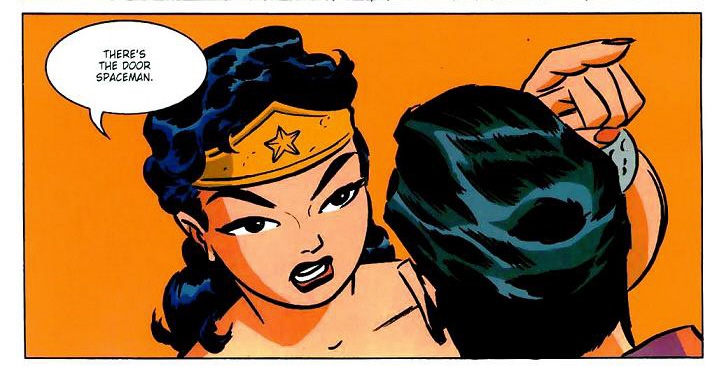
School was no better. Current Events, World Cultures, Criminology, Sociology, Spanish, Physical Education. We were learning about sexual harassment, and sexism, and seeing it actively demonstrated. Discussing it was good, but frustrating. There was very little that we, as high school students could do about the anecdotes we were hearing. For me, there was something very freeing about reading JLA. My sister complained that Wonder Woman didn't have enough panel time, was drawn as a doe-eyed innocent, and wore a ridiculous costume. But there was no denying the power she showed when she did show up. Zauriel stopped to start at her butt, Hitman made the x-ray vision joke, but as I was seeing, every male on that team still respected her when she did show up. No one dismissed anything she said.


I kept reading, though I spouted off about the same things my sister did. Despite starting out as a mouse, I somehow gained a reputation as the most fierce feminist in my school. Got into more than a few fights. When the "What mutant power would you have?" game came up in the geeky circles I ran in, I was usually assigned super-strength or some other physical power.

Time went on, I still read. I still heard horror stories, to the point that the only school I applied for was an all-girls liberal studies school. At the last minute, economic necessity, my father's example (he's a policeman), and the idealism gleaned from comic books won over. I signed up for the military. Everyone was in complete shock at this news. I plunged myself into the most masculine, traditionalist atmosphere available.

After Basic, I was a mouse. I couldn't act the way I did in high school and still get away with it. And adult can't hit another adult without legal reprisals, especially in the military. I wasn't a skilled debater, I often found myself backed into a corner during an argument so just stayed out of the controversal stuff. Having been already inclined to modesty (somewhere growing up I picked up the idea that it was a virtue), and now inclined to following orders, I withdrew for a few years. I generally followed the lead of stronger men and women. I had a friend at my first duty station, Liz, who had a great effect on me. She was a country bumpkin type. Too level-headed to get backed into an argumentative corner. She had no need to be violent, and was sexually active without worrying. I spent a lot of time around her at first, and after a while broke away. I latched onto a few more people, and clung to security blanket of military equal opportunity. I didn't experience or notice any problems on the job due to my gender, but I wasn't willing to explore the actual opinions of the men around me. I didn't want to have to argue around it. I dind't get my confidence or backbone back until I learned to discuss these things openly without getting upset, and without getting talked into a corner. This took years and after I got past that, I even found mice following me like I followed Liz. Through all that, of course, I still read.


And through all of that, even now, I still encounter those little moments. Little offhand comments, looks, and overall attitudes. Mostly off the job. Things not really worth getting into, and certainly not worth hitting someone or getting into trouble over, but annoying things nonetheless. I like the quiet moments, when I can take someone aside and discuss it. Sometimes I misinterpreted it, sometimes they didn't realize just how stupid they were being. Sometimes, I'm up against a brick wall. I'd love to punch through it, but this is the real world and there are ways of dealing with problems (long way, involving months of paperwork) that are acceptable.

Some days, you just feel like hitting something. Super-strength and invulnerability would be nice. So would a secret identity. I'd love to be able to take the jerks of the world to task immediately instead of waiting out the system. I want to act like a superhero. I want to talk, dress, and look like a superhero. I want to hit the guy who deserves it. I want to wear what I like and still be taken seriously. I want to say cheesy things like "I can't take time out for a social life, Steve Trevor, until the world is safe from crime!"

I want to get my own damned cat out of the tree.

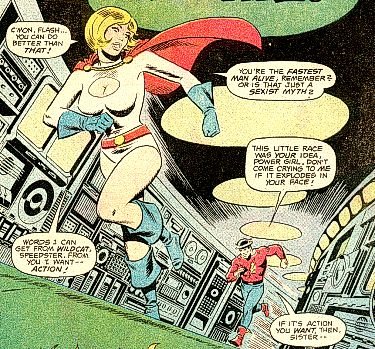
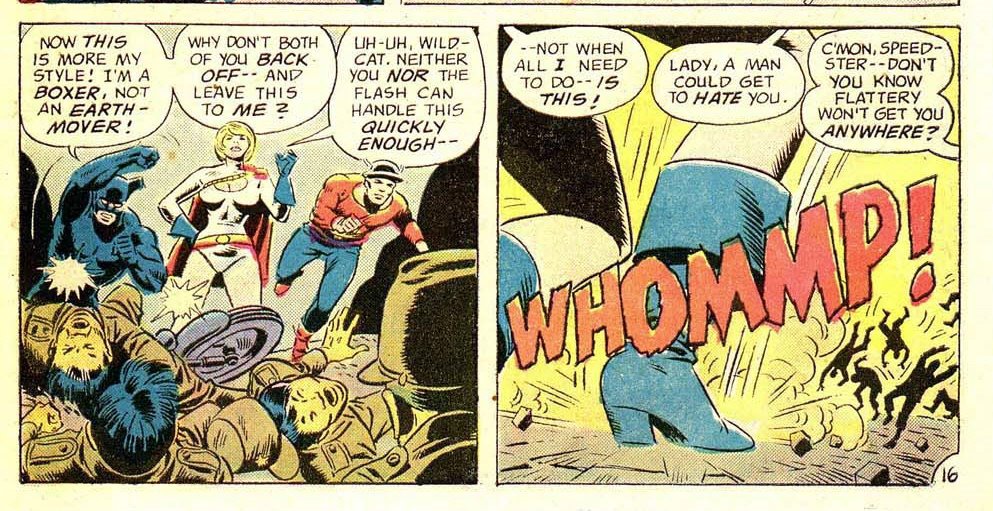
I see the feminine appeal of Power Girl. Here is a woman so formidable that she can walk around with a hole in her shirt and not worry about attracting unwanted attention. She shows up on the scene, and her colleagues say "Great! A heavy hitter!" She can apply my methods of problem solving, but she can also deal with these problems in a way not possible for any law abiding citizen. JSA #39 was pure fun, simply because I'd had the exact same fantasy years before, sitting in Sociology class and watching a Lifetime-style movie about how difficult it was to prosecute a stalker.


My tastes are matured, yes. I like some depth in a story, I chase symbolism, I'm interested in character interaction and wild plots and entertaining dialogue. Just watching a woman beat up a guy is not enough to make me like a book anymore, I generally want something more. But every once in a while, I still want my Adolescent Power Fantasy. Especially when I see sexism brought up by the characters in the story. If a female character has to deal with a jerk, then I want to see her deal with him in the most harsh way possible. The way I can only dream of dealing with him.

Which brings me to what I'd originally intended this essay to be about -- Witchblade #91 disappointed me. I was in the business of giving Ron Marz the benfit of the doubt. On the second read, I'd enjoyed his Green Lantern stuff, but was still iffy about his handling of female characters, so out of curiosity I picked up issues 89 to 92. Sara Pezzini sounds a little like Kyle Rayner in the narration, which is good actually. I liked Kyle's narration. And he follows through on his rules about supporting cast members getting pounded regardless of gender (Poor Gleason). And, for the first time, the main character of Witchblade came across like a three-dimensional person. But the plot let me down.

A federal agent is introduced who comes onto Sara. Now, right away, he's showing the narrative signs of evil (the writer was using sexual harassment as dramatic shorthand for Jerk) so I know he's not actually there as a sleezy disappointing love interest. He's there to get beat up. Yay! And he does get beat up, in issue 91, proving that the writer understood that a sexist bastard introduced in the first act must have his ass handed to him in the third. What Mr. Marz missed, of course, was that if the offended female character is the main character, then she is the only one with the right to beat up the offender. Here, a guest star did it. Sara never got a chance to touch him. Hell, neither did her partner Gleason and he said some things to him that really deserved a punch in the mouth.
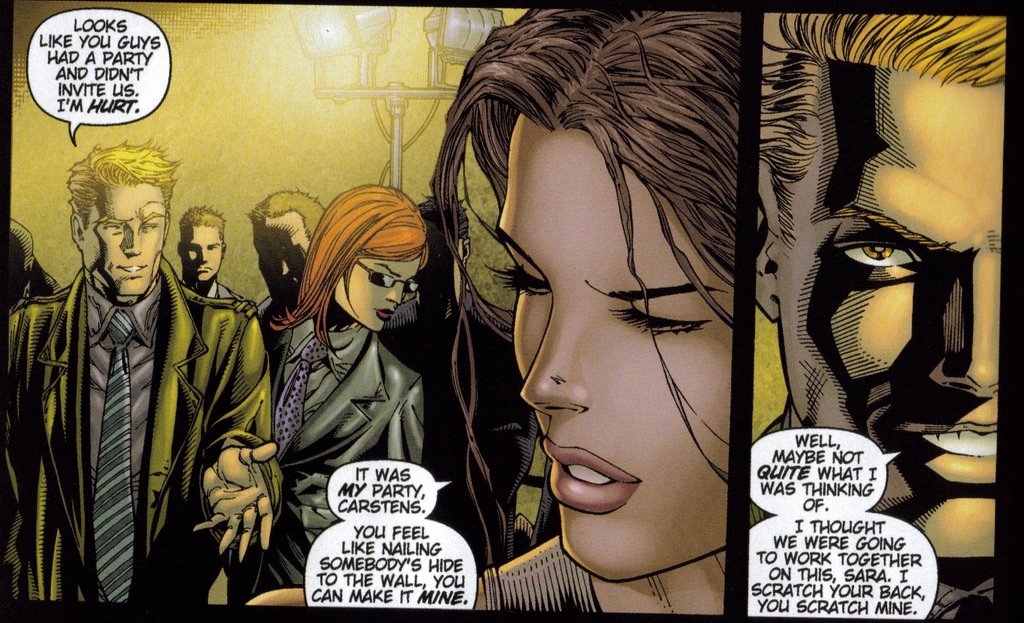
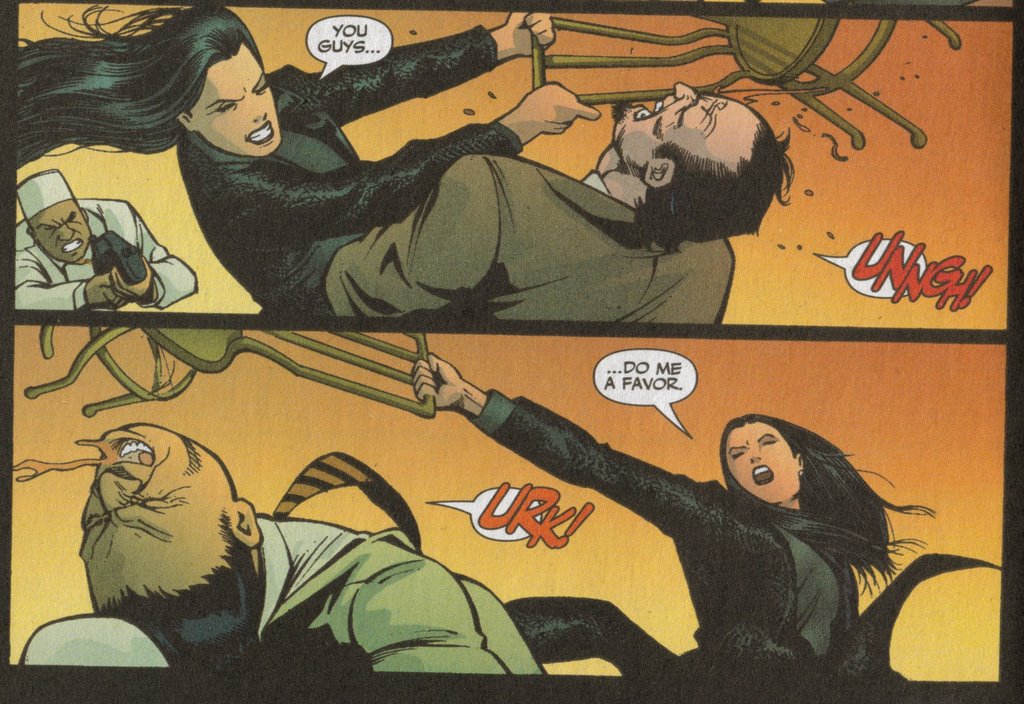

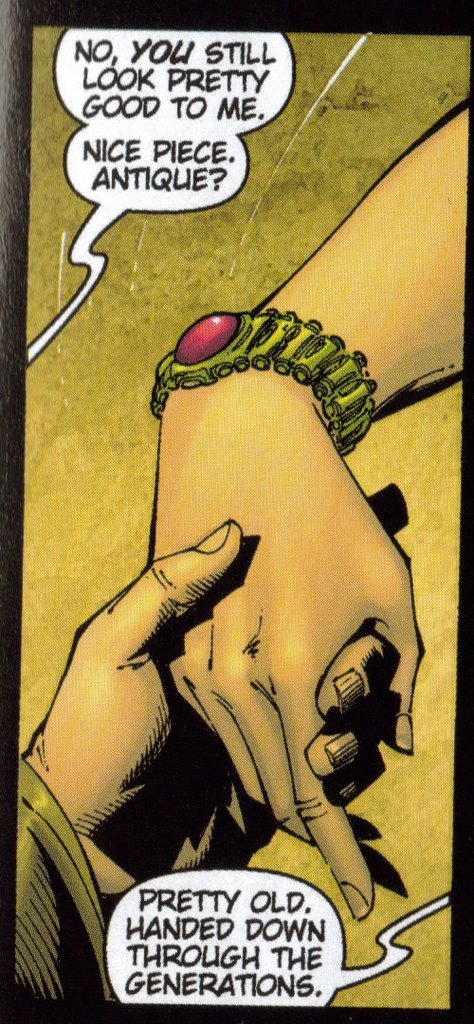
Now, this is just Marz's style of writing. I've seen him do this with Kyle several times, too, and it didn't really bother me because the subject matter was different. In a standard superhero comic, you are going to have stories where the main character doesn't personally solve every problem. I probably would have liked it in this story, were it not for the fact that sexual harassment against Sara was being used to characterize the guy. She had been hit on several times by this guy, and he even grabbed her wrist with his creepy hand. She didn't like him, he was sleezy and pushy. She reacted like a most woman in that position, she glossed over it and tried to get on with her job. He would leave soon anyway. I've seen this happen, I've heard of it happening to friends. This is a problem not far from my mind, or really the mind of most working women. We're not superheroes like Sara, though. We don't have a powerful mystical artifact like Sara does, and so we have to work through our problems in a rational, nonviolent way. But in situations like this, you do feel like hitting someone. It would have been undescribably satisfying to be able to vicariously kick this guy's ass through Sara.

Thankfully, Birds of Prey was next on the pile that week.

Tuesday, March 07, 2006

Darkseid

I have to admit, I never saw Darkseid as the terrifying figure Jack Kirby wanted us to. It's probably because I was introduced to him during the Morrison JLA run. That was during his downhill slide. Over a period of perhaps a decade, the Wicked Ruler of Apokolips went from a cosmic-level, plotting, looming threat to Superman's weekly punching bag. And so, once I did get my hands on a Kirby collection, I had sincere difficulty appreciating the majesty and terror of Darkseid.

Today, flipping through a long-abandoned 80 Page Giant, I am reminded of the fear and revulsion that this villain can inspire. I turned the page, and looked in the top lefthand corner of the book. My eyes were under attack! Such intense imagery entered through my sense of sight and invaded my other perceptions. I had to slam the book down, and turn away from this unspeakable fight. My friends, it was awful. This panel will haunt my nightmares until the day I die. I will never be able to see Darkseid as the featured villain without being reminded of these moments of terror.

And now, I will share with you, gentle readers, the single most hideous sight ever seen amidst the firepits of Apokolips.

Be aware that once seen, this sight can not be unseen.

The Horror...

Sunday, March 05, 2006

What Evil Lurks in the Heart of Ragnell?

(Disclaimer: I am beyond hope. Do not try this at home. For a more healthy way to deal with your negativity, try this advice.)

You find the damnedest things browsing Internet for When Fangirls Attack links.

Read on...

Today, searching for posts on women in the JSA, I ran across a blog about Wonder Woman.

Well, rather, it was a blog for posting pictures of people dressed as Wonder Woman.

Normally, when I run across this sort of site, I don't find any topical posts so it's not really worth my time. But here, at the very top, was an in-depth post about Wolverine. I don't read much Marvel, and the writer was verbose, so I just skimmed past it. I figured I'd find something relevant in the earlier posts.

There was a Donna Troy post that initially looked promising, until I scrolled down and saw a series of pictures of some woman taking off a Wonder Woman costume, piece by piece. Yeah, I thought to myself, That'll go over real well on WFA.

So I scrolled down further, and found a decent post on the origin of Wonder Woman and its feminist aspects. (Albeit, a erroneous one at some points. The writer labored under the delusion that being the JSA Secretary meant that Diana made coffee, got donuts and answered the phones. If this was true when she first joined, there's no indication by the time I started reading -- I have 1, 8, and 9 of the All-Star Archives. From what I saw, it meant she was an officer who took notes at the meetings, answered letters, and monitored the local papers for pertinant events. She took full part in adventures. But I digress.) I linked to that post.

Chris AIMed me to ask what's going on, so I linked him to the site and told him what I was doing.

Chris is a bloodhound.

Chris found Morrison-hating in 4.5 seconds.

There it was in... blue and lighter blue, a light jab at the Great Morrison.

I read on. It turned into a few paragraphs of pure, unconcentrated hatred.

I don't know why I was angry and shocked about it. I mean, people are entitled to not enjoy a Morrison book. Hell, one of my favorite bloggers subtly slammed the man for months before the awful truth was revealed. A few shy dissenters (of the All-Star Superman love that was currently permeating the community) even came out on his thread. Everyone was okay with it. The next day, he posted a panel of Hal Jordan getting hit on the head, all was forgiven and there was peace in the Blogiverse.

But this man, for whatever reason -- perhaps because of the Wonder Woman stripper, or lack of even the most basic knowledge of Robert's Rules of Order, or because he just wasn't as funny, or just because he was a professed Marvel Zombie and therefore had no taste -- could not be excused.

Somehow, Kalinara informs me, I've gotten the reputation of a serious feminist (or, well, as a serious as a feminist can get and still post pictures of Kyle Rayner's butt) in our little corner of the internet. Possibly because of WFA. In truth, I started that because I like to watch people argue. (I have the Feminist_Rage community friended on livejournal because of this. It's truly equisite arguing there, actually, as very rarely does anyone lose their temper in the comments, but every thread starts with an incredibly pissed off rant and there are numerous ways to offend any member) But I digress. The point is, I am not actually a nice person in any way, shape, or manner. I'm a troublemaker. On the D&D test I score Chaotic Neutral or Chaotic Evil depending on the day. It's not unusual for me to encourage a conflict to continue beyond its natural resolution, and it's not unusual for me to start one (between two other parties). When I'm being a peacemaker, it's normally because the fight isn't fun to watch anymore.

Because of this blemish on my soul, I felt an intense need to make his life uncomfortable somehow. I wanted to shower on his name with dishonor. I wanted to see him taken apart, piece by piece, psychoanalyzed, and thrown to the masses wearing his carefully obfuscated insecurities around his neck!

I was determined that I would read through the entire Donna Troy post and find a reason to link it on WFA. (In the interest of fairness, here's the post in question)

Anyway, I read through that entire post in detail and let me tell you that was tough. I suspect he added the pictures of the girl stripping to distract readers from the insanity he was actually spouting. A short way into the post, he confesses his love of Marvel over DC. Which is acceptable in the case of charming and intelligent bloggers, but as this person was neither charming nor intelligent, it was a strike against him.

Right from there, he goes into why he hates Morrison. It seems to boil down to either his handling of the Joker
or the Weapon X retcon. Maybe because after Morrison's revamp of X-Men he finds it harder to relate to mutants, being that Morrison validated the vaunted civil rights metaphor by treating them as a (mostly) harmless minority with their own separate culture, and not just a bunch of wierd, unpopular kids who looked strange but hid great and destructive power underneath their freakish facades (which we all know is the true appeal of X-Men), I'm still not sure, as again, I was distracted by the dripping poison of writing.

As the stripper unzipped (since when the hell does the front of Wonder Woman's costume have a zipper? Isn't that a gilded breastplate and a mystical girdle?) her bustier, he finally got back to Donna. He doesn't have much to say, so he intersperses it with covers until he gets into details about why he hates kid sidekicks.

Then he quotes Dr. Wertham.

Allow me to repeat that, he quotes Dr. Wertham.

I had to read through his explanation of why he likes Fred Wertham twice. It is reasonable to give a villified man a second glance, and the benefit of the doubt, so maybe he was on to something. After I read through the entire thing, I reread the most controversial part. This guy wasn't on to anything. His was the sort of explanation that sounds reasonable when you read through it too fast. But once you slow down, look at some of the more unsettling comments (such as how he doesn't feel its homophobic to believe that Batman turned young boys gay), and realize it's being followed by a topless Wonder Woman fondling her own breasts, he loses some of his credibility.

Then he gets back to Wonder Girl. You can tell, because he starts posting covers again. It's not long before he starts bitching about Crisis on Infinite Earths and how the Multiverse confused him too much. Meanwhile, the stripper moons us and it's back to Donna and the explanation of John Byrne's retcon.

Nothing that could justify a link to When Fangirls Attack.

It was the most fucked-up thing I think I've ever seen on the Internerd. I ran through a mental list of places I could send this link to for a proper dissection and mocking. I understand that the moderators of the Gentle Scent of Pee in Your Longbox welcome fodder like this, so I was tempted to send it to them. I'm sure there's a number of Donna Troy fansites and Titans/Wonder Woman enthusiast message boards that would be interested in his opinion. On the other hand, Grant Morrison's following is loyal, rabid, and contains some of the most intelligent and stubborn members of the species. I considered the fun a forum like Barbelith Underground would have at his expense (Fortunately, a fine upstanding community like that would have nothing to do with an person such as myself). Worst of all, I considered feeding him to Twisty Faster for digestion at I Blame the Patriarchy, I'm sure her readers would have a lot to say about the stripper (but it would doubtless be painful to read the radical feminist opinion of Wonder Woman and our beloved hobby).

After making my way through The Insanity, Chris and Kalinara talked me down from the edge of Chaotic Evil, and I decided to write a post exploring my reaction to The Most Fucked-Up Post on the Internet.

Which became harder and harder to do without describing the original post.

I've realized, writing this post, that what I really, really, really wanted was first crack at him. In fact, I did a Technorati search looking to see if anyone had gotten at him first. No one had.

If you are reading this, it means I've given into the darkest part of me. The post in question was a labor of love. The writer slaved long, hard hours putting it together. He agonized over every word and picture for the maximum effect. I'm sure he looked back after posting it with pride and a sense of accomplishment. He felt he was giving something worthwhile to the internet. He's a living, breathing human being with thoughts and feelings and a right to express his opinion in whatever manner he sees fit!

And here I am, the Evil, Two-Faced, Sneaky Bitch, plotting to ruin his sense of self-worth. He's opened himself to the world, and I'm targetting him from my own Fortress of Blogitude, surrounded by a crowd that I am confident will feel the same as I do. I'm actively marring his efforts, belittling his manhood, and calling the negative attention of intruders to his safe, private space for sharing his dreams, emotions and ideas. And then I'm planning to email his link to others who would mock and degrade him for their own judgmental amusement. Don't I know that imbeciles have feelings too? Shouldn't I nuture and encourage him like a good woman? Coddle his moronic opinions in the name of free speech and diversity? Indulge his unrepentant snobbery? Acknowledge his right to pass himself off as an intellectual as he spouts his hateful nonsense about my favorite writers and objectifies my gender without taking a few good jabs at him myself?

I should be ashamed of myself! I'm not doing this to be constructive, or help, or add anything worthwhile to the community. I'm picking on a harmless idiot! I'm a bully. I'm secure from the safe perch of a blogger who holds the same opinion as the vocal majority. Would I be wallowing in my own darkness like a warthog in dead squirrel guts if I was not confident of the popular opinion? I should be guilt-wracked for such insidious, cowardly behavior. Don't I feel bad about subjecting another human being to treatment which would, in all likelihood, make me cry?

Why, no, actually, I feel kind of warm and fuzzy inside.

I'm going to go hug a kitten now.

I call her "Betsy"


Because of the comments for my last Manhunter post, I was able to get a real good chuckle out of this panel.

Kate's staff, the most phallic symbol of aggressive weaponry in the series, is described as female by Dylan.

How could you not love Dylan?

Saturday, March 04, 2006

LT of "I Read Comics"

The other day, I received an e-mail from a lady who found When Fangirls Attack. She gave me a few compliments, and told me she was planning to plug it on her podcast. So, naturally, I went to her site and this was the first thing I saw.

It was nice to see I wasn't the only one to notice this.

(Oh, and the podcast is interesting, too. She links here whenever she does one)

Friday, March 03, 2006

Thoughts

I only read JSA #83 and Detective Comics #817. I probably would have picked up more, but all of the back issues of Manhunter that I'd asked for came in from their other store, and so did the issues of Batman and the Monster Men.

(Spoilers for JSA #83, Detective Comics #817, and Jonah Hex #4 follow)

Read on.


Detective Comics was really enjoyable. James Robinson's primary assignment seems like a return to the status quo of Batman. And by status quo, I mean a recognizable Batverse from people who know it by the movie, the cartoon, or just common pop culture knowledge. I'm actually very happy about that. Mainly this is because of Page 5 (Page 6 counting ads). Page 5 saw the return of one of my favorite Batman characters to the regular recurring cast. Someone I've been waiting anxiously to come back since the "Officer Down" storyline. When I saw his fat, unshaven, cigar smoking face I had to put the book down so I could dance my "Harvey's back!" dance. Then the little old lady downstairs pounded on her ceiling and yelled, and I had to sit back down and read quietly again.

Despite opening with a murder, it was definitely a brighter, lighter Batman than we've seen in a while.

JSA had equally dark subject matter, but the tone was also lighter than the book had been for years. I'm happy to see Power Girl, Terrific, Courtney, and Jay alive. The absence of Sand is notable and worrisome. The continued absence of Atom-Smasher is a joy. I was happy with Alan. When Jennie died, the expectation was that Alan would grieve but get on with his life, and her brother Todd would have a meltdown. Well, in the Manhunter preview art he looks perfectly well adjusted an cheerful. And decidedly not evil. Alan, on the other hand, attributes his seeing a ghost to PTSD, and references how off-center he's been since his daughter died. Credits Jay with keeping him sane. Anyone else who thinks Alan's going to get worse before he gets better, raise your hand.

Anyway, I had trouble enjoying this issue because of Dr. Mid-Nite. Pieter Cross is on my list of favorites, you understand. I went out of my way to get Batman and the Monster Men (after ignoring it) because someone likened it to the 1999 Dr. Midnite miniseries that brought us Pieter. (I think it was Chris but I'm not sure)

Anyway, firstly, what was Pieter doing in Gotham? Are they going to station him there now? I mean, I know he's not in an ongoing, but Portsmouth was set up well enough to support it. And he did have a likeable supporting cast, headed by Camilla. Johns even showed us glimpses from time to time.

Secondly, if Pieter's going to see ghosts that accuse him of killing them, why not the person he actually killed when he got his powers? Why not his mother? Why these nameless, lost patients that he didn't personally know?

Then there's his behavior. I think he panicked too much when he lost his goggles, but that could be just me. It just didn't feel like Pieter.

What really bugs me, though, is this panel. It not only implies that Pieter doesn't believe in the afterlife now, but that he never did.

Which directly contrasts previous characterization.

This annoys me. The characterization was put in place, I think, to differentiate him from Mr Terrific. Terrific, for most intents and purposes, has the same surface personality. You need to get seriously into the characterization to tell the two apart, and this was one of the big differences.


It was a little off-putting to have one of my favorite character show up so... off.

Aside from that, I got Jonah Hex #5 but haven't opened it yet. Possibly because I didn't read Jonah Hex #4 until Tuesday night. I was impressed. You've all heard my complaints about Spider-Man/Black Cat #6 and it's unfortunate plot device. Well, here it is again and it works quite well.
Jonah Hex is hired by a father to bring in the young man who sexually assaulted his daughter. When Jonah does bring him to town, the daughter, who's mute, hits him. Later on, she passes him a note saying that the young man didn't do the crime, and that she'd helped him escape. Jonah spends the issue trying to save the wrongfully accused young man, while the girl takes care of herself and ends up saving them both. In the end, when she communicates what happened very clearly, no one but the culprit challenges her story. I even noticed that in one panel where the townspeople are asking him where his explanation is (in the clear mood they won't believe it), the more prominent extra was even female. It made me think of David Welsh's complaints about victims never getting conventional justice. Mayleen got conventional justice, Western-style justice, but still, it was conventional and it relied entirely on her testimony. I wonder what he thought of this issue.

I don't think I can form a coherent review of Green Lantern Corps: Recharge #5 of Infinite Crisis #5 right now, but I was very pleased with both. I'd tell you about Manhunter as I now have the entire series, but I'm not finished reading. You see, some unscrupulous person (I suspect the cat) has move issue #9. I could have sworn I had it when I left the .

I haven't read Batman and the Monster Men either. The owner of the LCS tracked down a copy of issue one for me, and it was a copy signed by Matt Wagner. 'm not much of a collector, but there's something intimidating about a signed copy. Especially when it's one with a certificate on the back of the board, with a scary looking silver seal holding the bag together. Chris assures me it won't hurt it, it's meant to be read, but it's still intimidating. I'll get past this eventually, I'm sure, but as it is I'm afraid to open it. It's the seal, I think.

Maybe this weekend I'll get a bout of bravery. Then I'll talk about it.

Thursday, March 02, 2006

Seeking Symbolism

I freely admit to missing the symbolism on the first try sometimes. I miss it even when it's obvious. I have my off days, you understand. Times when I bypass it. And then, suddenly, someone points out something so unbelievably simple I feel like an idiot for missing it. I've been accused of obliviousness.

More often, I've been accused of reading too much into it. You see, I'm actually obsessed with symbolism. To the point that it's unhealthy. To the point where I miss blatant symbolism looking for subtle symbolism. The thing about symbolism is once you train yourself to see it, you naturally look for it. If it's a symbol that speaks to you and applies to your life, it will pop out at you. With me, it's always been gender symbolism.

Read on.

It started with fairy tales. I found a copy of Fearless Girls, Wise Women, and Beloved Sisters in my high school library. The editor had been fed up with traditional fairy tales like Cinderella and Snow White. She didn't like the thought of what they could be teaching her daughter about life. Instead of updating these familiar stories to reflect a more balanced viewpoint, like many people do, she tried a different approach. She researched and tried to dig up folktales with better rolemodels. She came out with a beautiful volume of authentic folktales that portrayed women as strong, clever, heroic masters of their own destiny.

At the end of each story, there was a little editorial note. It lays out the reasons she chose the story, what it demonstrated about women's lives, some personal impressions, and sometimes a comparison with a more traditional story. She touches on symbolism, of course, in these notes. Specifically, how it applied to women and what kinds of lessons we were getting from traditionally fairy tales. It's still one of my favorite books, and was one of the first books I sought out when I got to my first station.

While I was looking for it, I found Goddesses in Everywoman in the mythology section. The back of the book said "Psychology/Women's Studies" but it sounded so interesting I had to read it. It was on the Greek Goddesses, one of my personal favorite subjects. The writer was a Jungian psychologist (and Jung's quotes and theories were about to pop up more and more as I read about religion and mythology) who saw the Greek goddesses in women's behavior patterns. She wrote about these different sets of motives, values, personality each coexisting in all women, some more active than others. A committee of archetypes, in everyone's head. It was plainly written, accessible to the laywoman, and full of points where you could see yourself and your friends.

Now, I'm not a psychology student. I've never taken a literature, folklore or mythology course. I've never set foot in a women's studies class. But I did become a little obsessed with symbolizing. This led into more and more books analyzing more and more stories. I studied up on interpreting my own dreams. I found a really good school of thought that taught you how to reason out your own dream symbols. For practice, I started applying what I learned to my own entertainment (movies, comics, books). Relating it to your own life and experience just naturally happens.

So, if you're like me, after so many books, your thoughts become consumed by symbolism. You eat, drink and breath symbolism. Until you're sitting in a lecture on cable connector repair and thinking about the symbolism of the female cannon plug connector (sockets) and the male cannon plug connector (pins), and how the female connecter can be either a receptacle (passive) or a plug (aggressive) -- and especially what it tells you about yourself that you (the only female present), are the only one in class who wasn't confused by all of those example pictures of receptacles with sockets, when you are trying to find the mating connector to a plug that has sockets and all you need to do is find the proper size and shape and order it with pins instead of sockets. It was funny, though, when the instructor tried to clear up confusion by describing the receptacle as female -- when while it is passive it's a fairly phallic symbol that is covered by a cannon plug. And everyone knows pins are male and sockets are female anyway, so calling a receptacle with pins female is just even more confusing.

You need a break, but it's really hard to ignore by that point. Even the subconscious stuff the writers don't even realize they are writing.

Especially the subconscious stuff the writers don't even realize they are writing.

No one should need to be told comics are heavily symbolic. It's the pictures. Everyone needs at least a basic understanding of dramatic shorthand to understand a comic book. Visual symbolism is a given. The really fun part is when the plot gets symbolic. You can walk through it like a dream and isolate the hidden messages.

This isn't exclusive to the great writers. Sure, everybody knows when to expect a deeper meaning behind the action. The name is on the front cover, after all. I've learned to tune out the symbolism from Grant Morrison and Alan Moore for the first reading. It's not that I don't love it, it's that there's so many distractions I need to shut that part of my mind off to follow the plot. (Barring, of course, gender symbolism) I've learned to zero in on the plot to the detriment of the theme. Guys like Morrison and Moore understand multiple layers of symbolism. You can read their stories and find several different sets of meaning for most symbols, and work them together in ways that make sense. They're doing those on purpose. They give us exceptional symbolism.

I love the symbolism of the normal, though. Most writers have some level of understanding about symbolism, and they make up for it with instinct. That's when we get the stuff that just randomly fits together. The average work-for-hire writer who probably didn't mean to do that, but it fits and reinforces the point. The multiple writers who somehow string a secondary character's entire life under one central theme, while not even using her to further the same story objectives. And they keep falling into the same symbolic lessons. This way, the plot becomes part of the characterization. It just fits, beautifully.

That's really what I love about superhero comics. They are serialized fiction passed from writer to writer. We get to watch the continuity. We get the fun of digging the symbolism out of continuity, and making it whole so you can observe the entire picture. I enjoy having to work the little inconsistencies into a character's personality, and finding what was probably mischaracterization by an unfamiliar writer adds a deeper facet to a character. In the end, you not only get a complete picture of a three-dimensional human being, but an underlying lesson that has been reinforced repeatedly. Appearance after appearance.


It's why I prefer to ignore the writer. Elayne asked me about that in the comments once. "I persist in believing there are no bad characters," she said, "just badly-written (or badly-drawn) ones. I'm curious as to why you never mention the people who write and draw the characters you examine. These characters literally do not exist unless they're being written and drawn by a real person, so it stands to reason that any discussion of their "personalities" would need to touch on the actual people writing and drawing them." It's partly because it destroys the continuity. If something is "out of character" then a deeper aspect of the character that explains this behavior does not exist. It's pulling back the curtain and destroying the magic. It takes the fun out.

And besides, I have my favorites. I like some stories that really aren't very well-written or well-drawn because the symbolism spoke to me personally, or the plot, or just something the character did. I suspect some writers just think like I do, so their stories seem more valuable to me than arguably better crafted ones. I need to learn to stop getting defensive about certain writers, characters and stories. I usually fall back on the symbolism. That's when I can practically hear people sighing, and can see their eyes rolling from across the country. "You're reading too much into this" signals the end of a lot of online conversations for me. I also get "You're just looking for reasons to hate it!" too. When in actuality I'm looking for a reason why I hated it.

My thoughts on symbolism have gotten me blasted for the umpteenth time about a certain character. A character I examined hoping I'd start to like her again and came out much more disgusted than I was by her surface portrayal. I don't know why I'm so upset about it tonight. Maybe because no one else seems to think like I do. Maybe because I knew when I answered the question I'd get jumped on by bystanders. Maybe because I've laid out these reasons a few times before and I specifically said that they won't talk me into liking her. Maybe because earlier on the thread I expressed a small amount of sympathy for her fans. Maybe because I made a comemnt and brought it up, but I was just sick of the vitriol wasted on this character death, which probably won't even take. I just know I'm too angry to respond right now without getting into a huge fight.

(My apologies to those who saw the Helligan pics and expected a Seven Soldiers post.)

Wednesday, March 01, 2006

That's the Outsiders?

I'm still too tired to give you guys any worthwhile insights. Instead, you can go see Kalinara talk about ass-kicking females, Shelly talk about heroes killing, Scipio talking about Superman or Chris talk about the Hulk hitting things.

Me, I'm just going to make fun of the horrible fashion sense of OYL, as outlined in the revealed March Outsiders cover. (Devon was right on the last member)

Shouldn't be Spoilers since it's coming out this month, but here's a Warning and a cut anyway


First off, I hope Thunder's hair implies time-travel to the seventies and not just a return to that fashion. I mean, I'm not an advocate of the blonde wig (which actually wasn't bad, as wigs go, for a secret ID. The contrast of skin and hair color insured that no one paid attention to her distinguishing features, just the blondeness), but this a pretty dated look.

And if I never see that cleopatra bob on another Asian woman in the DCU it'll be too damned soon.

That must be the rumored False Nightwing. Dick's hair would never go so limp.

Grace actually looks pretty cool.

And then, there's Owen. Poor Owen. A pastel-blue bandana over an otherwise bare neck. A coat with that colllar. This outfit would work with a white shirt underneath the coat, but even for a Flash villain this is pretty bad.

And what is he doing with these people anyway? Didn't the DCU just spend two years making the Flash villains... y'know.. bad guys again? I hope he's a Sciety plant, or the whole team is evil now, because it would suck to finally get a Captain Boomerang who actually makes sense as a Flash villain ad then go and make him good

And does anyone else find his hair a bit... feminine?

Tuesday, February 28, 2006

Once again, too lazy for original content...

I've got dayshift again tomorrow (they have a brakes guy teaching us about electronics wire repair. It's not pretty), and it's getting late. So, here's some of the things I found instead of writing a new blog entry for you guys:

This Wednesday's Shipping List.

A good post on Emotional Predators -- I've fallen into this trap myself. A lot. I usually end up with with the paperwork at the office while everyone else goes out to the plane, because I can't tell my fat, desk-bound boss to find someone else and I haven't learned the fine art of delegation.

Kevin's thoughts.

A post from a woman trying to teach her daughter not to judge people by their clothing.

Some interesting images.

I cannot stop giggling when I watch this.

Scipio is not alone. (So far, she hasn't told any fairy tales.)

Why don't I read Blockade Boy more regularly?

A shopper stumbles across comic book culture. I'd ahve loved to have seen his face. Did he just stare at the site name and copy the link without looking, or did he explore the site and the opinions within, maybe leave with a new understanding of his fellow man.

Eh, probably not.

All of Whileaway is talking about writer Octavia Butler's death. I'd never heard of her before, but I'm inclined to track down some of her books. Surprisingly, I've only seen it discussed on feminist weblogs (that second one is Not Worksafe because of the background) so I was wondering if the rest of you guys knew.

And, to end on a brighter note. A lot of you have probably seen this, but it's become a guilty pleasure of mine. So positive. So sappy. So unlike me.
Enjoy.

Monday, February 27, 2006

Best Let-Down Ever Written


This must be a blind first date. She's recoiling at his touch and getting an "emergency phone call."

And that is the best excuse not to stay with someone I have ever heard in my life.

Sunday, February 26, 2006

The Good Daughter

I've been complaining for quite some time about the female characters at DC who, because of certain aspects of their concept, send very uncomfortable anti-feminist messages and reinforce unfortunate stereotypes.

I've read about the younger, female versions of established male heroes.

I've read about a beautiful talented young woman who has strength and confidence but is so uncomfortable with leadership and direction that she turns from a warm caring person to a confrontational bitch when in a leadership position. She also reinforces the stereotype of the beautiful woman who leaves a positive, loving relationship to knock boots with a total sleeze.

I've read about a woman who became the only character in a certain franchise that I couldn't stand. The daughter of two powered parents, and the twin of a powered brother, she inherits powers from the father (as does her brother). In order to be a hero, she has to actively reject her birth mother and everything the woman stood for and embrace her father. She loses that inheritance in order to protect her male relatives, and starts to develop her mother's powers. These are immediately cast aside for a return of her paternally inherited powers, which can only happen through the help of her boyfriend! (This was still a nasty message even before it was retconned into a worse one) From there, she further descends into a symbolic cautionary tale.

I've read about the most skilled martial artist in the world, a 16 year old Asian girl. She is trained from an early age and built into a killing machine by a man who also trains her to complete silence. He is, at least implied to be, her father, and still plays a part in her life. She overturns this man's influence in favor of another father figure, and takes on the mantle of a woman -- who had taken on the mantle of that second father figure. Her mother.. Well, let's face it, this character's situation is a whole post in itself. I'm still waiting on my own copy, but it's got me more incensed than the above character (and I like this one!)

Then we have the female characters who started out with a bright happy future, only to have sexual trauma retroactively injected into their backstory for reasons I'm not quite sure of, but which could be: a) dramatic shorthand for female character strength, b) complete lack of respect for the issue, c) stupid writers, and d) "'Cause we kin't do that to a Guy!" Yeah, real enlightened.

And of course, there's the beautiful situation wherein Wonder Woman is forced to sacrifice everything she hopes for and believes in order to save Superman. She snapped the neck of a telepath who was (at that moment!) controlling Clark's mind. Sure, it wasn't as necessary as Superman's killing the 3 Kryptonian criminals who's power he had already permanently removed with gold kryptonite and who were posing absolutely no threat at the time, but you know, given that she was in a situation where she three options (Kill Max, Kill Clark, or get killed herself) I'd say we can give her a break. No, she gets villified. By the same guy (Holy Double Standard, Batman!) who was so accepting of Clark's confesson about the 3 Kryptonian criminals.

But that's all okay now. All of the above crap can be excused, because I have Manhunter.

(Spoilers for Manhunter #19, which I hope that you have read. If you haven't and have no intention of reading it, I hope this changes your mind.)

Keep Going


Yes, Manhunter, the most progressive female comic book character on the market.

Yes, Manhunter. Kate Spencer.

Yes, the same Kate Spencer who left her primary weapon out so her young son could find it and get hospitalized.

The remorseless killer who brutally slaughtered Copperhead.

Who blackmailed a man in the Witness Protection Program to fix her superhero equipment.

Who stole that superhero equipment from a Federal Evidence locker.

Who smokes in federal buildings.

Despite being a federal prosecutor.

Who sent a summons to the Justice League Headquarters.

Yes, that Manhunter.

Who'd you think I meant? One of the guys?


Kate's concept is awesome. She is the granddaughter of the JSA Founder, the Atom. It's possible (but not clear in any of the issues I own) that she inherited superstrength from him by way of her father, Walter Pratt. Kate's a legacy hero, but not as the Atom. She took a completely different legacy, the Manunter. She took it by way of stealing equipment from a federal evidence locker. A locker she had access to because of her career, a federal prosecuter which was her personal choice. Kate's power comes not form her paternal legacy, but from the suit and accompanying weapons that she acquired herself. Right there, she's past a conceptual problem that plagues female legacy characters.

Unfortunately, I haven't had a chance to read the whole series (I have 7-12 and 16-17 on order right now) but I picked up 18 because of Todd Rice. I couldn't help but be struck by the role reversal inherent in the plot. Her ex-husband Peter is kidnapped, tied up and tortured (in a similar position, I believe, to Black Canary in the Longbow Hunters). He's being tormented by a predatory female villain. Kate is on the way to rescue him.

Right there I was thinking to myself, Andreyko is doing this on purpose. He's a subversive. There's role-reversal all over the place in this issue.

Kate's father, Walter Pratt, kidnaps her son Ramsey and her ex-husband Peter in the hope of getting a bone marrow transfusion. Kate's son is not a match, forcing him to go after Kate directly. This is good overturn of the cultural tradition that a male grandchild is worth more to the family than the daughter who bore the grandchild.

Usually, a gay couple in the supporting cast will be female (Maggie Sawyer and Toby, Lee and Leigh, a bunch of Amazons in Perez's run but two in particular who's names escape me). There are exceptions (Pied Piper doesn't count because he was almost always seen single, but there was Mikaal and Tony in Starman -- another comic book that liked to turn convention on its ear -- but Tony was a staunch background character with little personality other than he loved Mikaal) but generally lesbians are more prolific. Here it's a male couple, both of whom have well-developed personalities -- Todd's an established character brought in for Damon, and Damon is a resident supporting cast member tied to Kate since the first issue. They kiss in this issue, and a female secretary in the background watches with a dreamy expression. She's fantasizing.

There's other objectification of men by women in this book, mainly by Phobia, the female villain. She's aroused by Peter's fear, and goes out of her way to lay her hands all over Walter's body when he's waiting for surgery.

Like a traditional story centered on a female hero or any hero who is less than morally spotless, there is a pure-hearted huntsmen/white knight to help our hero fight her evil stepmother father. She (Cameron Chase) spent issue 18 seeking a magical technological artifact from one of Kate's allies. This ally commonly provides Kate with such weapons. Ladies and Gentlemen, the part of the Lady of the Lake in Manhunter will be played by Dylan Battles. (Yeah, that one seems like a reach, but he actually comes out ofa pool of water to give Cameron the teleportation device in issue 19 and I, with all of my reading where they drive home the point of the Goddess as Armorer in old Celtic Legends can't get past that -- I think even subconciously Andreyko is flipping stereotypes. Which, when you realize that even when they do try to flip stereotypes they usually subconciously reinforce them, is pretty damned impressive)


Any doubts I had that this stuff is on purpose were dispelled by the name of the villain's hideout -- "the old Marston place." It's a really unlikely coincidence to play with gender stereotypes in a comic book and then drop the name of Wonder Woman's creator.

And the next issue, we get to see her fight her Dad.

You see, Walt is a total bastard. He killed her mother. He's put her son and ex-husband in serious danger. He's pushing her around and insulting her.

Now, I suppose she's going to be a purehearted heroine here. She's going to be merciful and help save his life and forgive him his wrongs even as he's incarcerated for the rest of his natural life, right? That's what any child in the father emnity stories does. She redeems the family through love. That's how you keep a woman sympathetic, right?

Wrong. She gets to go all the way here. He doesn't get to be the redeemed father figure. He gets stomped like an evil mother/stepmother -- and nobody regrets his death (especially the reader).

Even better, he gets stomped personally by her. She not only denies him his lifesaving medical treatment (for which her bone marrow, and the villainous Dr Moon -- the male villain Kate killed last issue -- are necessary), she fights him to the death. And she mouths off to him during the fight. That's the fun part.

And yes, there is intervention when the fight turns against Kate. By Cameron, who delivers the teleportation device that Kate uses to fry her father.

After this, we find out that the battle caused a miscarriage. Peter Hernandez feels this was a weak story point -- "The only problem with the conclusion was with the final scene and the miscarriage. Only because it was like Walt getting the last laugh as he hurts Kate one final time...and hasn’t he already hurt her enough?"

I think it's just more of the death imagery that surrounds Kate. For starters, she smokes. Smoking is beyond simply representing someone's attitude towards society. It's beyond emphasizing crankiness (effectively done with her contrast to the optimistc, fair-haired Damon). Every message we get in our society drives home the point that cigarettes are connected to cancer and slow lingering death. Kate, most often shown with a cigarette, is toking death.

She is a dark haired woman in red. Now, I know a few of you are going "Hey, that's sex, isn't it?" Maybe with someone else, but Kate's red costume also includes really sharp clawed gauntlets and white eye-lenses. This is blood we're looking at. To me in particular this calls to mind menstration and the associated dark goddesses (Morrigan, Kali, Hecate -- You know, the death goddesses) but I may still be thinking of Shining Knight.

In her first story arc, she kills Copperhead. Copperhead's a snake villain. Snakes are heavily symbolic of rebirth and eternal life.

Her costume is a suit of armor two men have died in. She has the gauntlets that belonged to Azrael, the replacement Batman who is famous for going too far and killing people. Her primary weapon, as Chris testifies, is a "staff belonging to Deathstroke the Frigg'n Terminator"

I've heard superheroes in DC referred to as "the gods" occasionally and compared to the Greek Pantheon a few times. If this is the case, Kate's one of the dark goddesses. She's very much about endings. She's a character that takes us into the "after the battle" aspect of superheroics. She takes the villain to trial and works to get him punished for his crimes. If Justice isn't served at the bench, she takes it on herself to play executioner and end things once and for all.

Her weak spot is being a mother (she fails as a parent in the same way Golden Age male superheroes did, by her absence and dedication to justice), possibly because Motherhood is full of beginnings and middles. That's not her realm. Compassion isn't where Kate's comfortable, because compassion isn't direct and blunt like she is. Compassion prolongs things.

Does this make her unlikeable? Perhaps.

Does this make her interesting and complex? Definitely.

Does she fill a niche that is vacant in the DCU? You bet she does, on more than one level.

I've yet to see a negative review about Manhunter. I've heard several bloggers, like Scipio and Heidi recommend it (but not post on it). When I do see reviews, they tend towards the postive.

I just feel bad it took me so long to notice this book.

Saturday, February 25, 2006

Amazing What Good Coloring Can Do

The cover to Wonder Woman #1 as found on Newsarama.

I take back some of the bad stuff I said about Terry Dodson. He can draw a woman with biceps who believably has the Beauty of Aphrodite. That's impressive.

So many artists freak out and remove all trace of organs, showing a little stick-arm figure, and the few who try sometimes go the other direction and lose all proportionality when drawing the figure. It's nice to see definition in her arms.

Unless this is all on the colorist. In which case, I hope the same colorist is on the interiors.

I hope he can manage a distinctive face though. I mean, scenes that feature Diana, Donna and Hippolyta (I refuse to believe she's not coming back) out of costume could be a nightmare telling the three apart.

I wonder if Diana has experiences like this lady describes: "..a significant percentage of men feel absolutely compelled to announce within moments of meeting me whether or not the sight of a muscular female causes them to become sexually aroused."

(Oh, and she'd better be towering over the rest of the Justice League this summer. I'll accept Martian Manhunter looking her in the eye, but Batman had better be craning his neck.)

In lieu of actual content...

A random panel from The Golden Age Flash Archives, Volume II.
Enjoy.